42°19′ N   83°02′ WINDEPENDENT CITY GUIDE · HU / ENDETROIT + MICHIGAN
EGY NEGYED
DETROIT
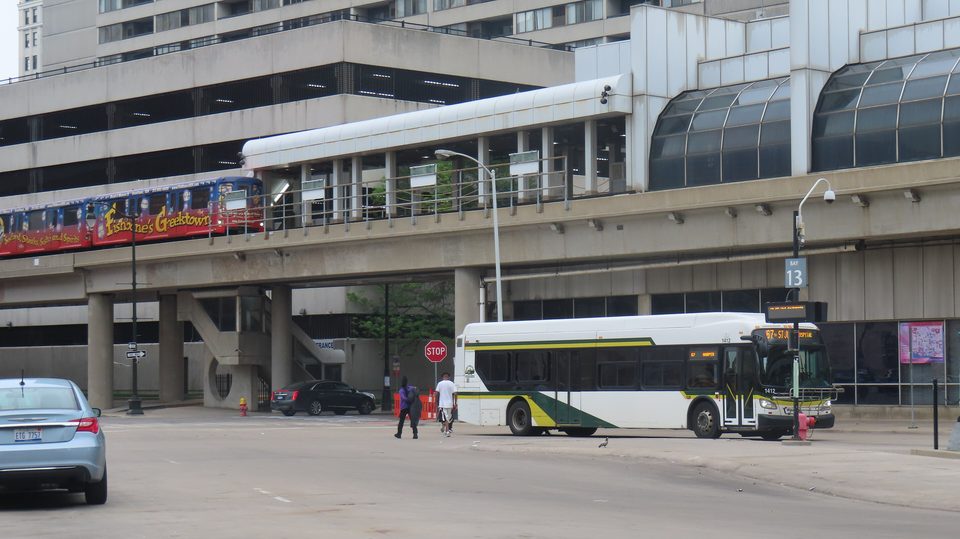
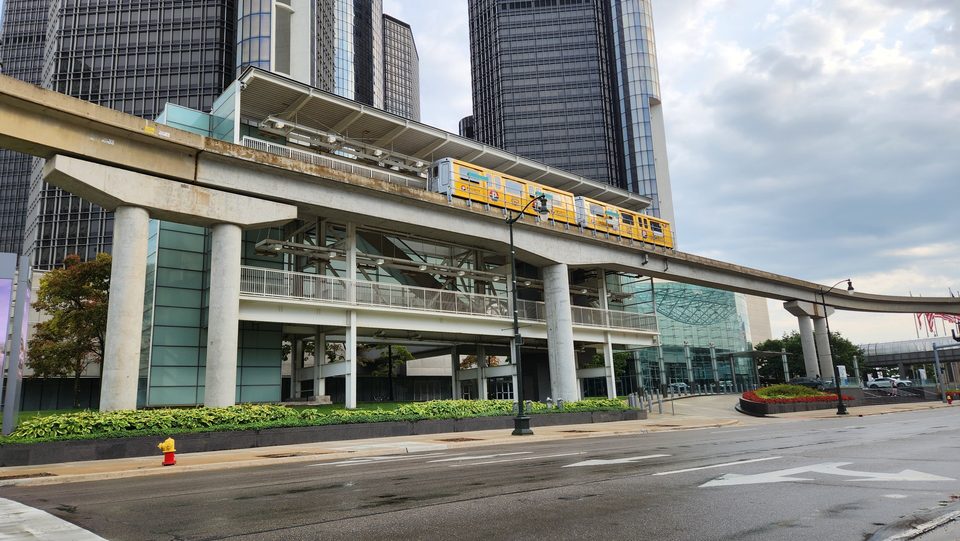
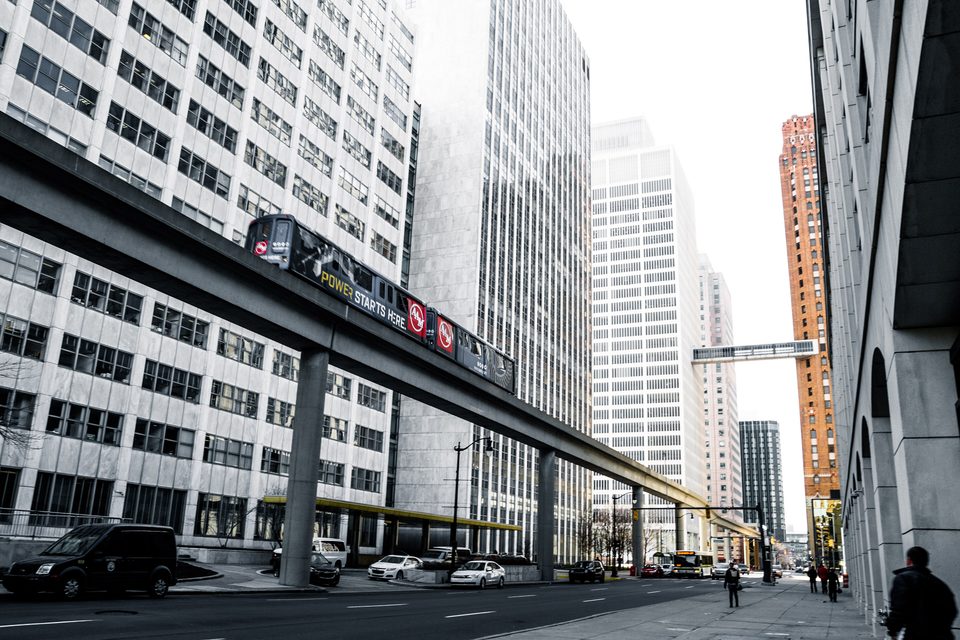
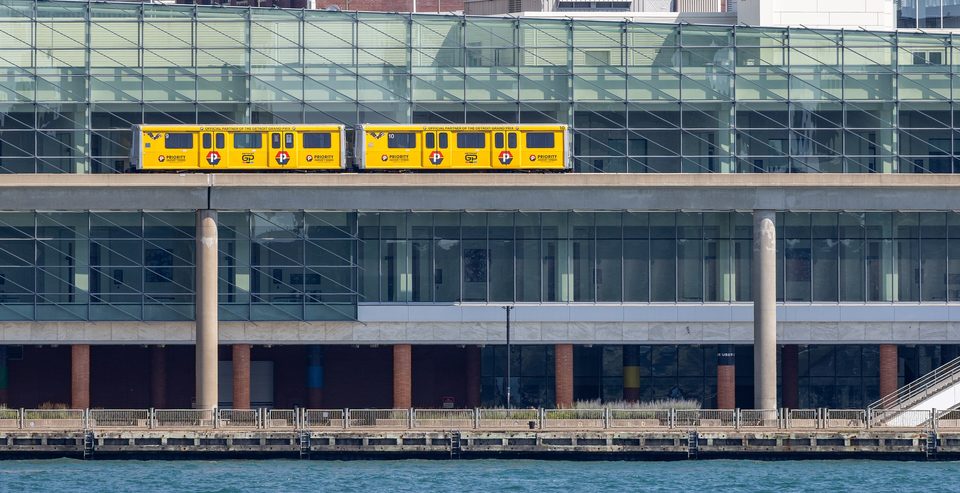
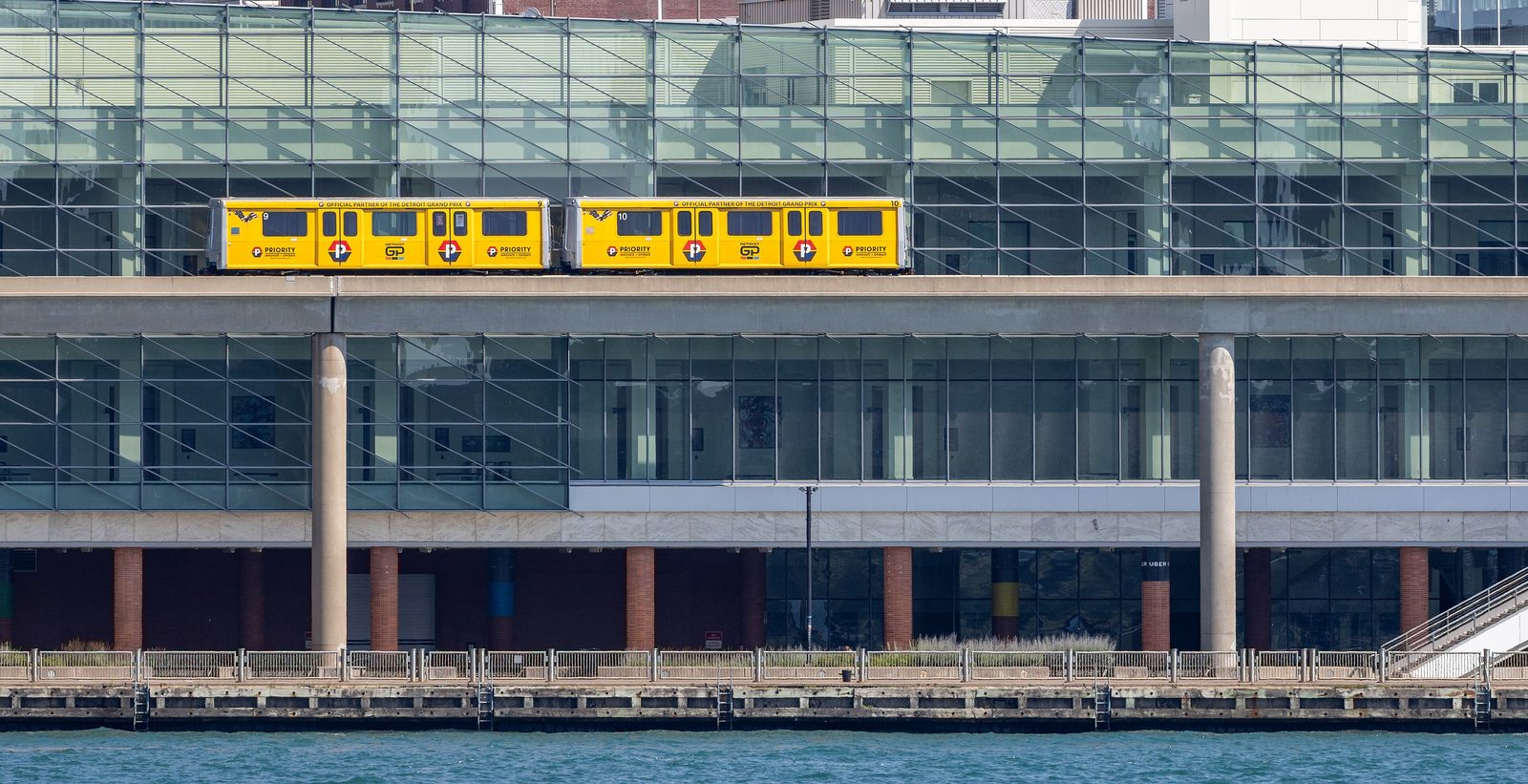
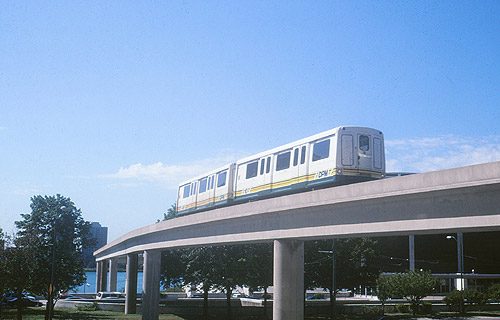
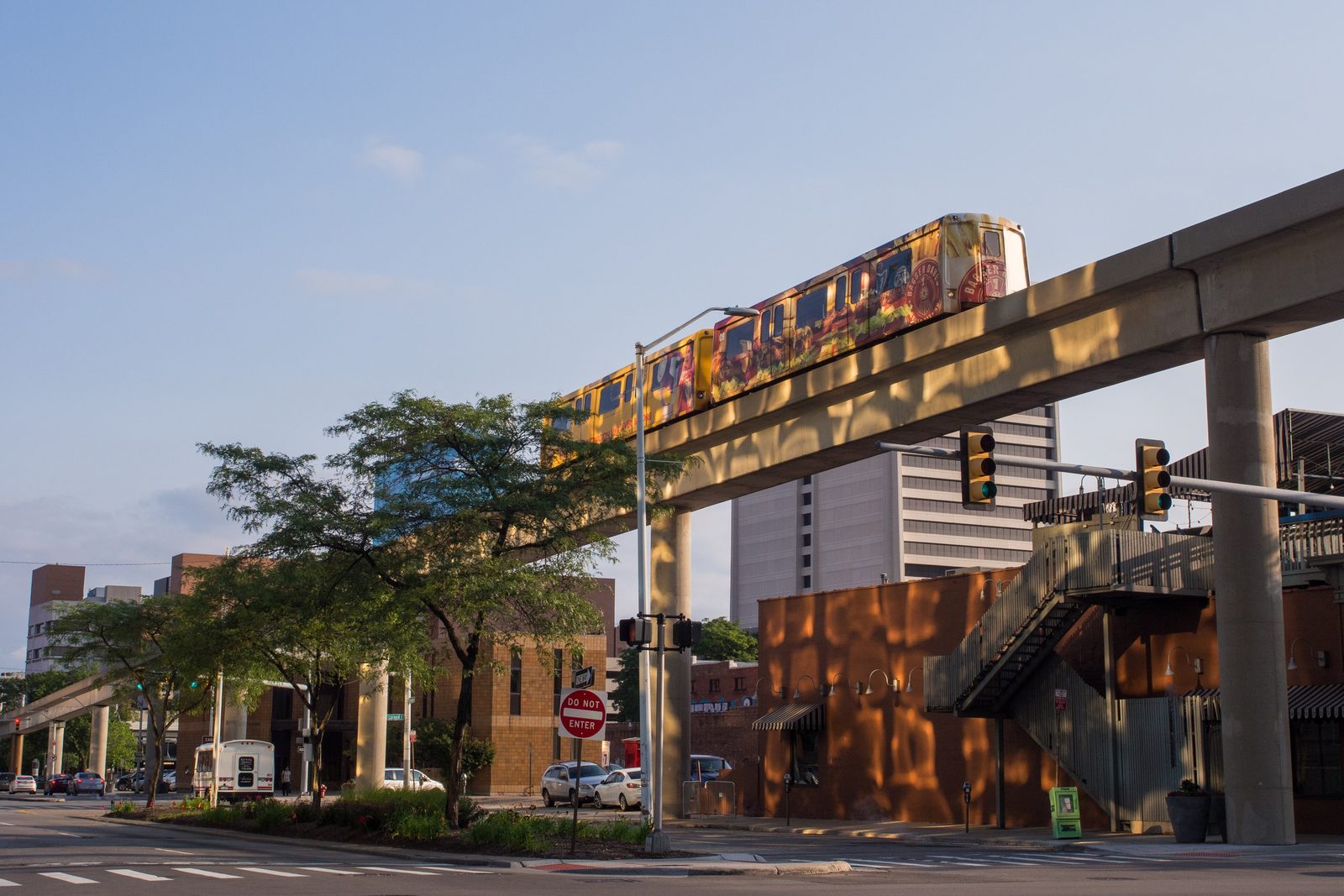
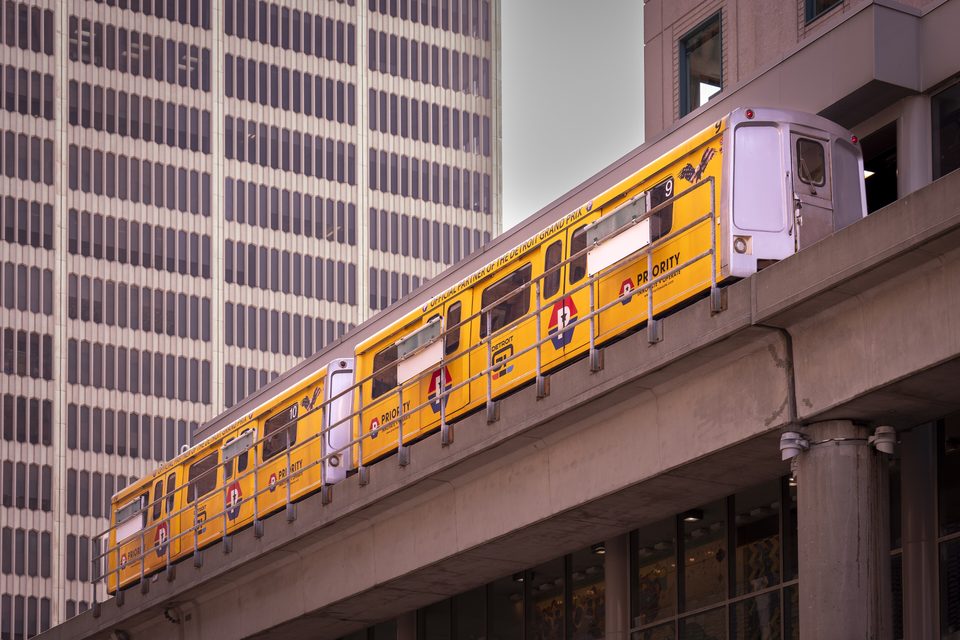
A yellow People Mover train on the elevated guideway in downtown Detroit (2024)
Mobilus In Mobili · CC BY-SA 4.0

Places Transit / ¼

Detroit · since 1987People Mover

Driverless cars forty feet above downtown

A 2.9-mile one-way loop, 13 stations, 20 artworks and a fifteen-minute ride above the Detroit River, the Renaissance Center towers and Campus Martius. It is free, and it is the legacy of a subway network that was never built. Hop on.

4 trains on the loop right now (timetable)
Loop
2.9 misingle track, fully elevated
Stations
138 built into buildings
One loop
≈ 15 mintimetable: 14 min 59 s
Opened
July 31, 1987turns 40 in 2027
Fare
Freesince January 2, 2024
Rides in 2025
1.32 millionofficial DTC figure

01 / Why an icon?

The train everyone mocked, and now everyone loves

The People Mover is a piece of an unfinished future. In the 1970s Detroit planned a subway, commuter rail and a rapid-transit network, and President Gerald Ford promised $600 million for it. The loop was to be the downtown distributor of that network. The subway was never built; the loop was. So an isolated yet captivating machine, first mocked as “the train to nowhere”, became a symbol of downtown Detroit.

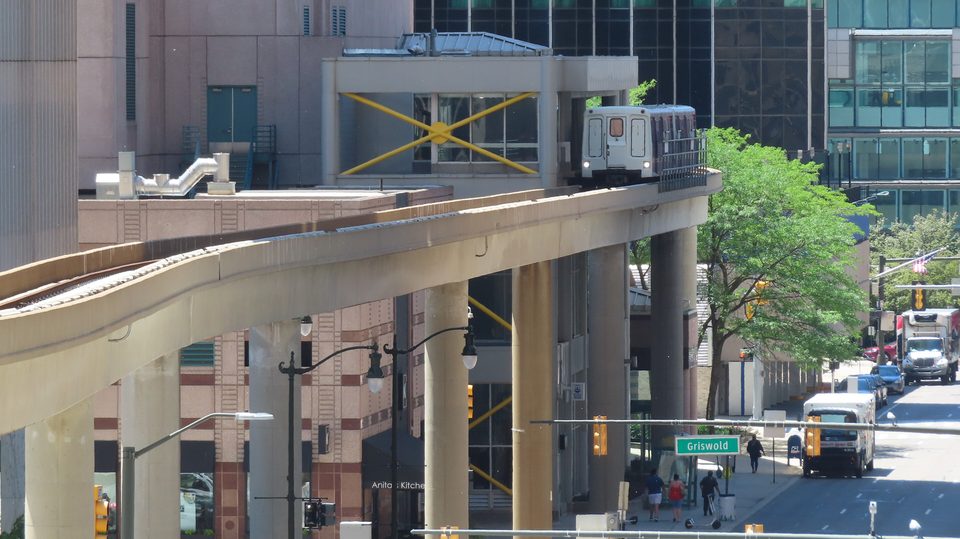
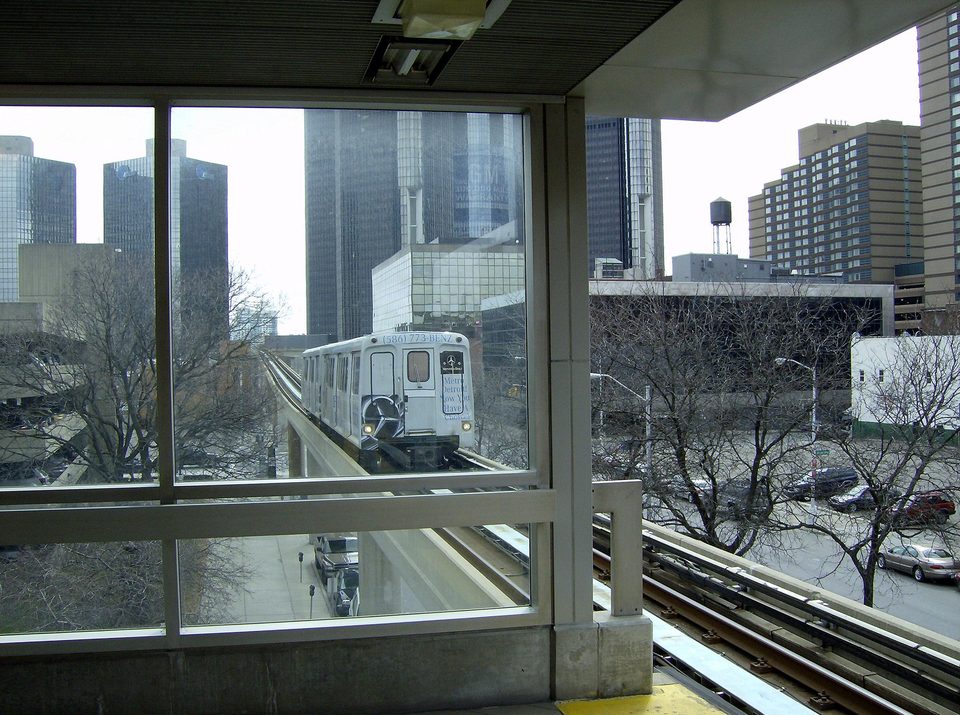
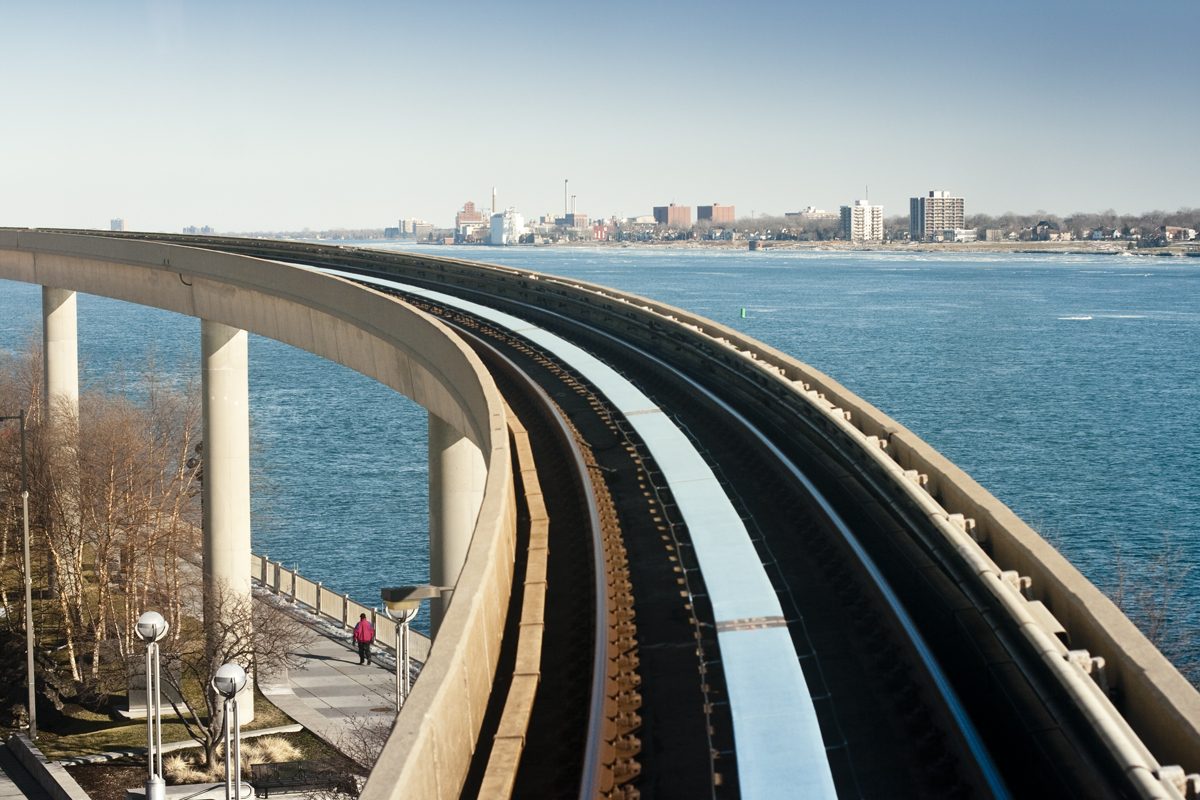
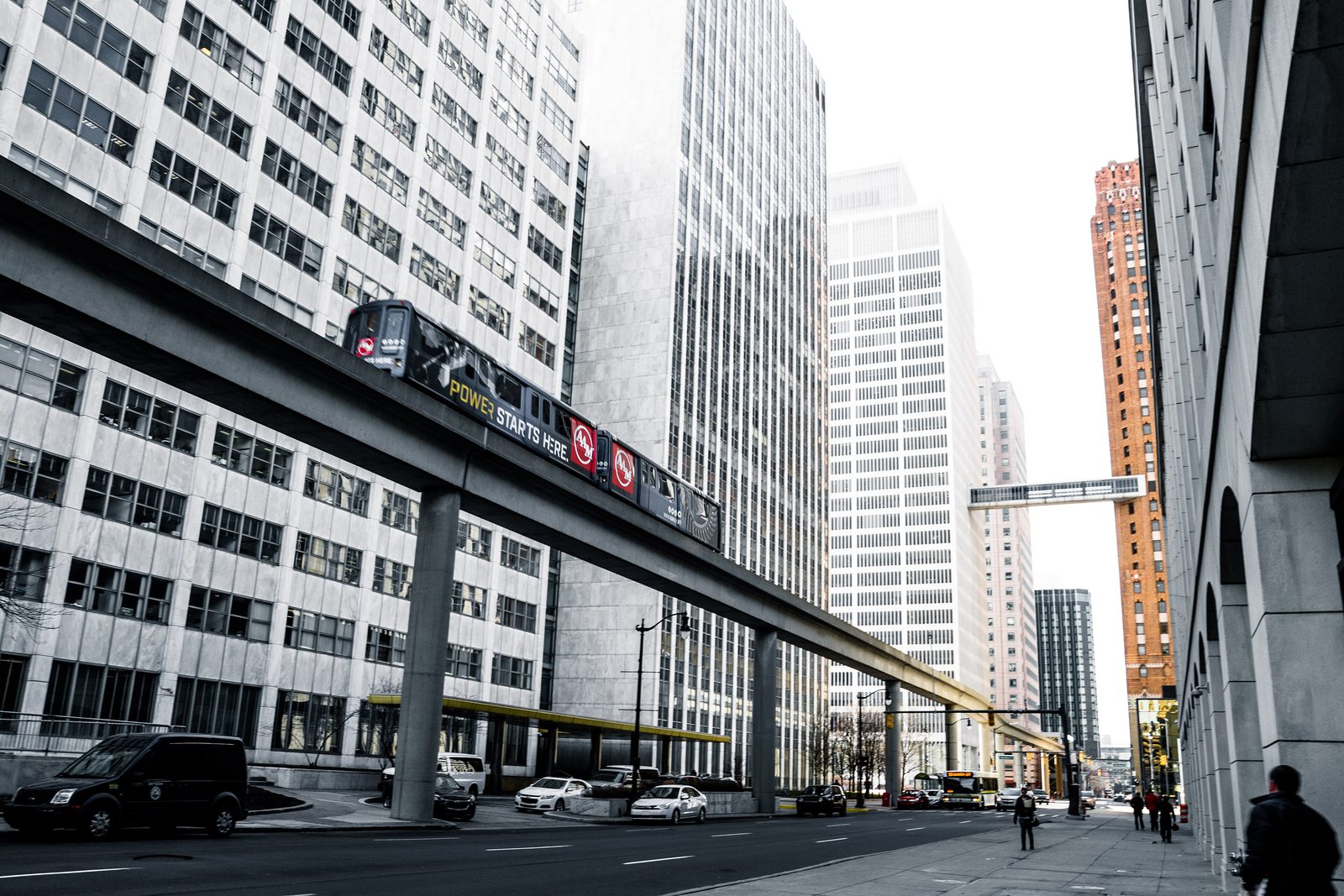
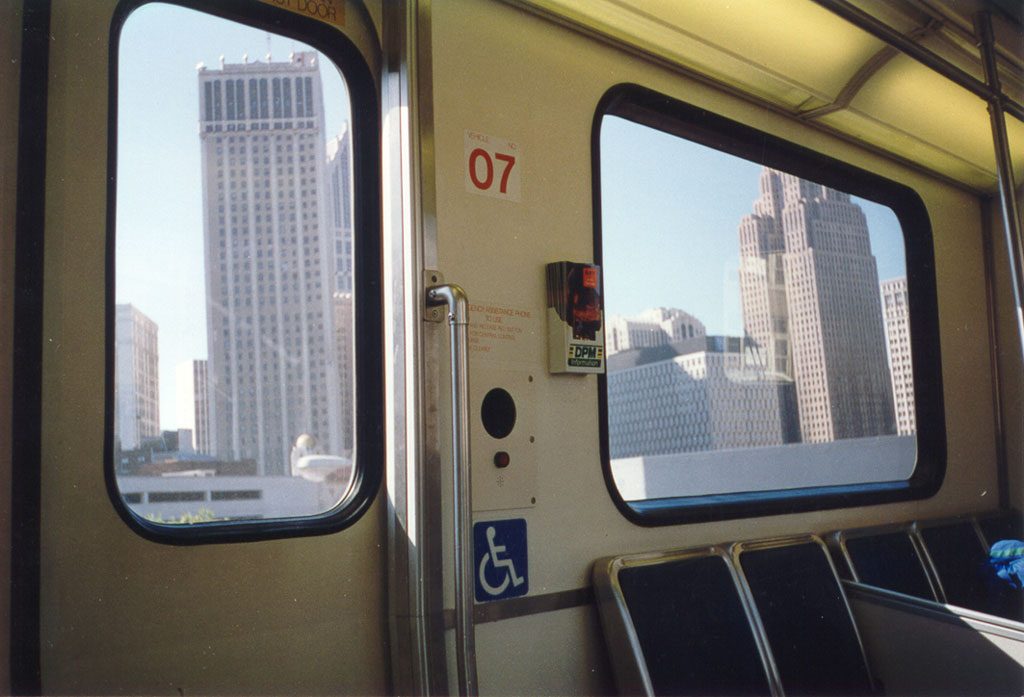
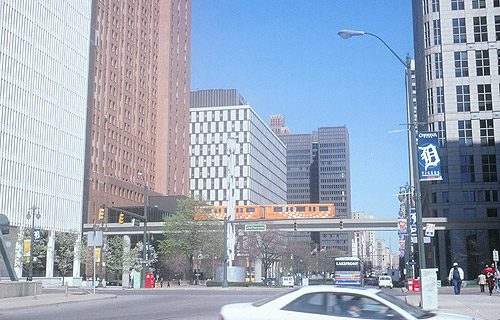
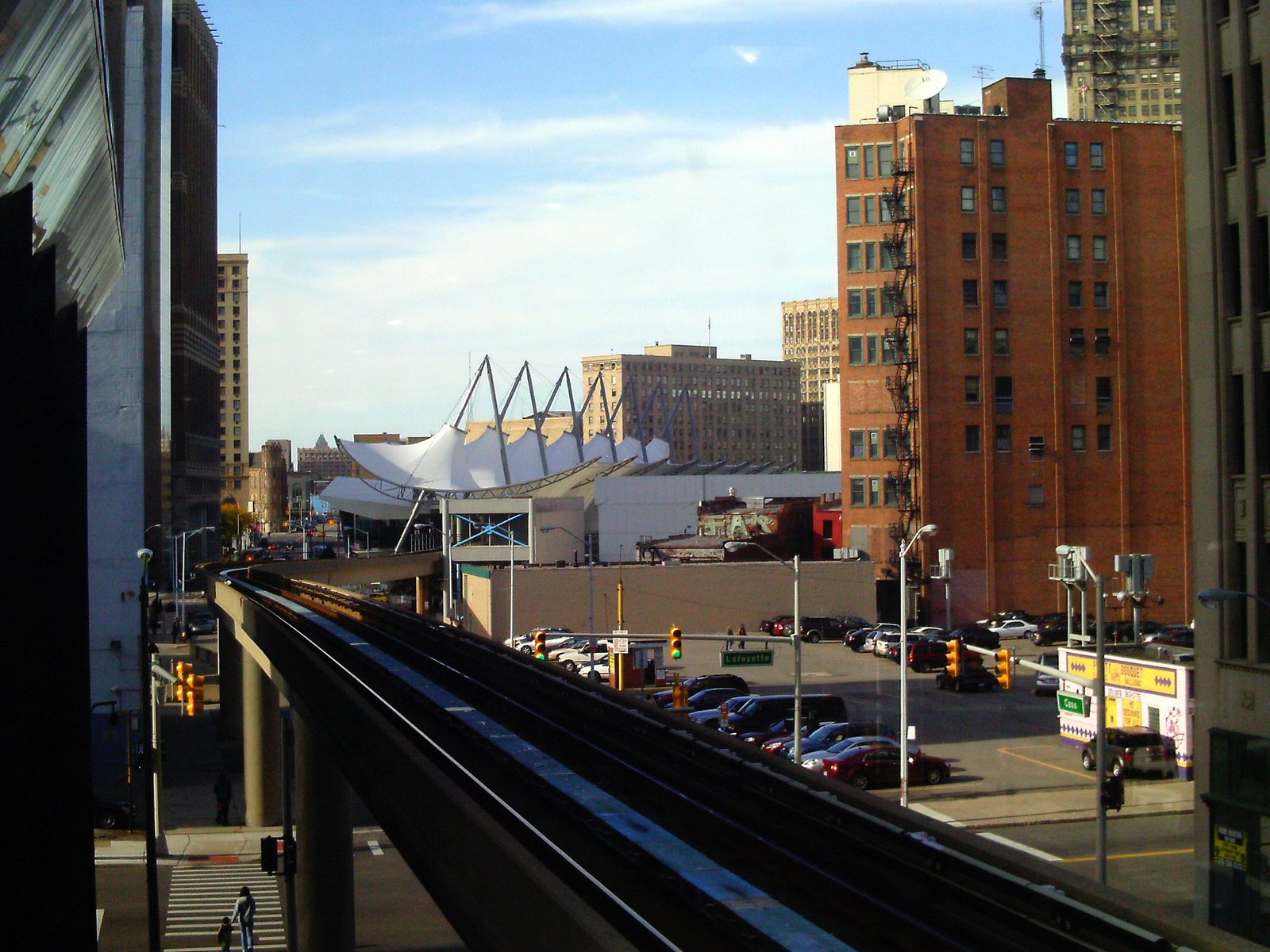
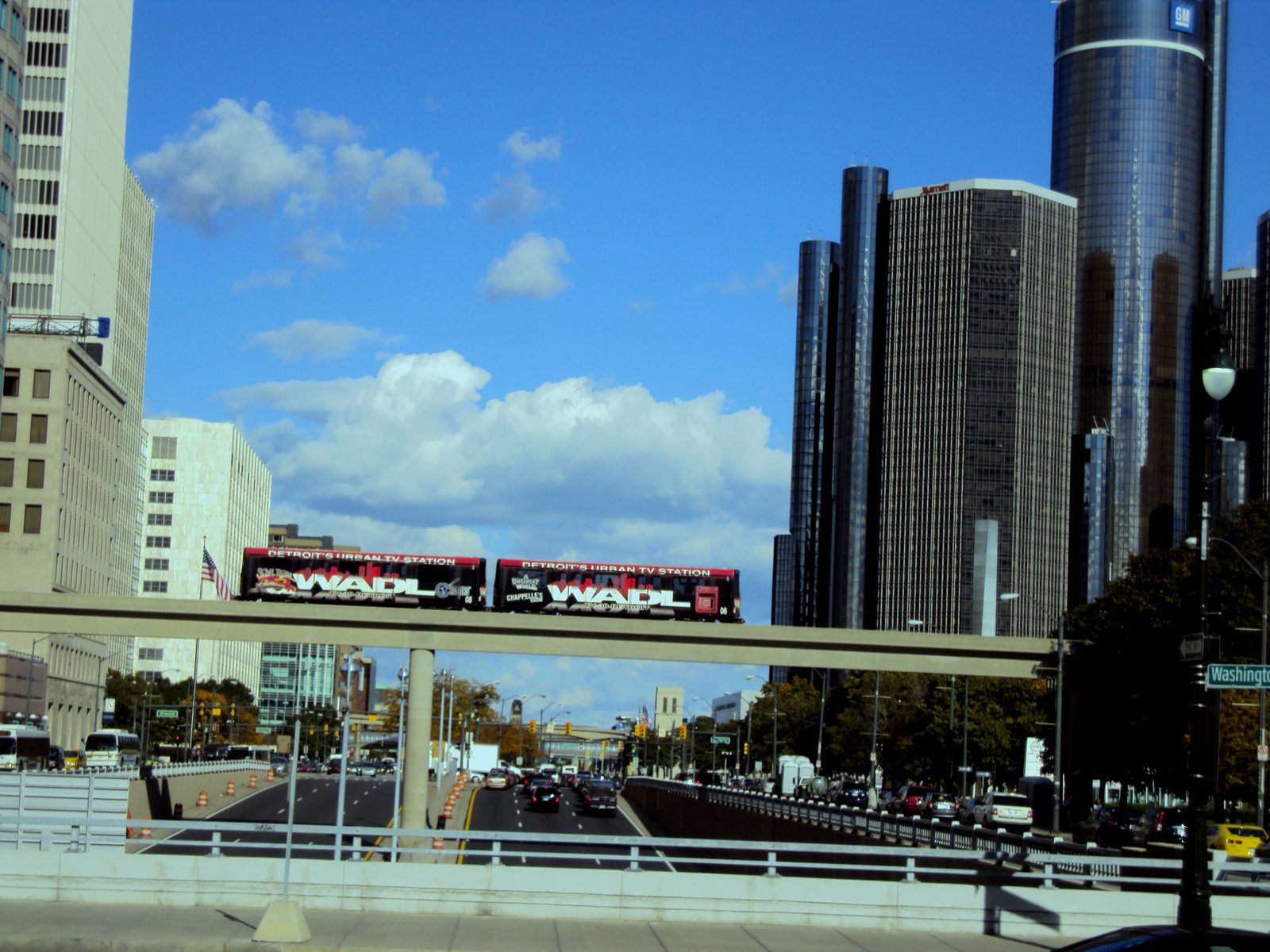
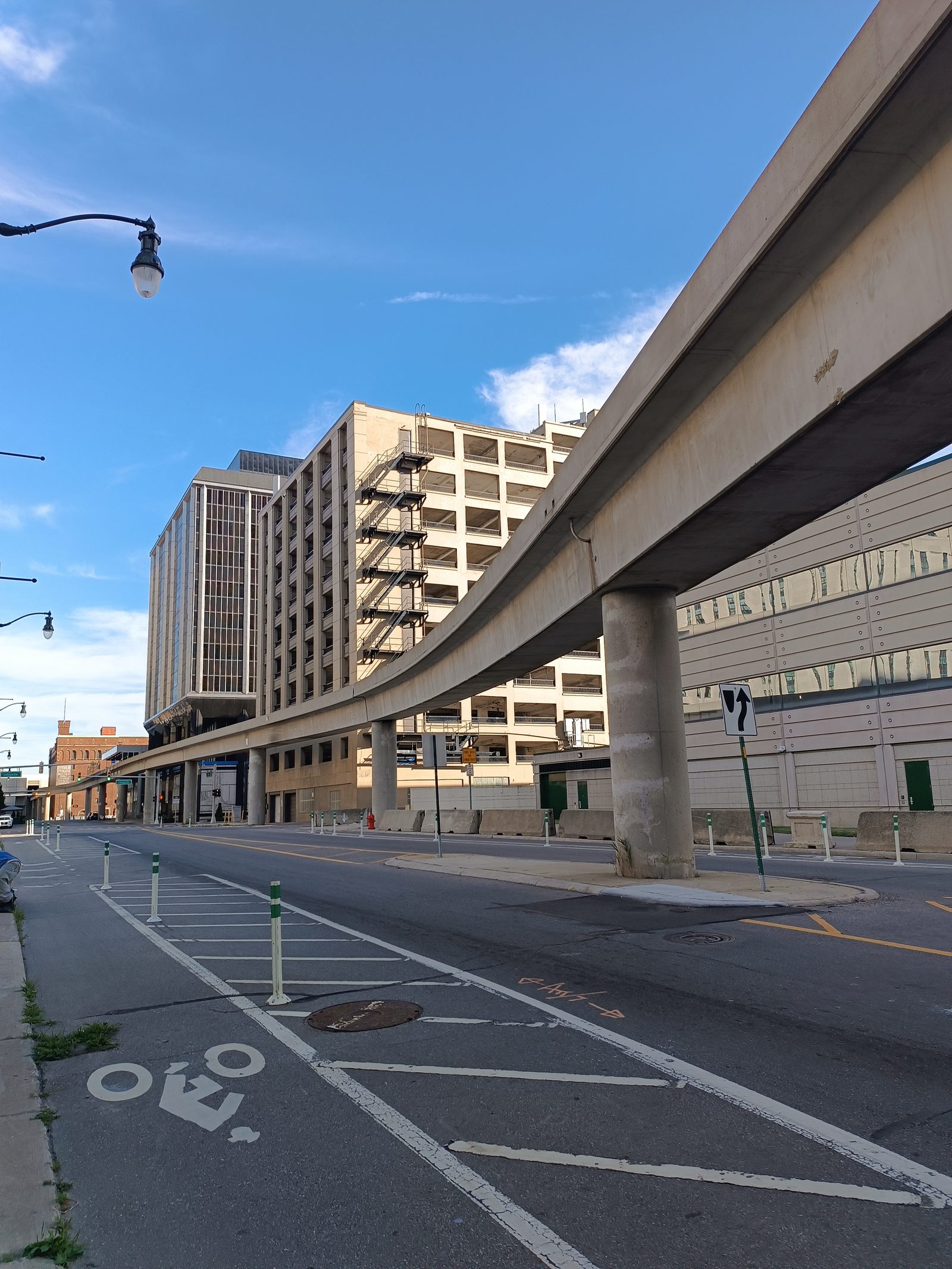
Driverless cars glide along the concrete guideway, pushed by linear induction motors: above Cass Avenue, along the Detroit River, through buildings, on the third floor of the convention centre and the fifth floor of the Millender Center. From the window you see Canada, the Renaissance Center’s glass towers, the Guardian Building’s orange brick and Campus Martius. In fifteen minutes you have circled all of downtown.

Every station is a small museum. In 1984 Irene Walt’s volunteer commission made sure the 13 stations received 18 new artworks: Pewabic tiles, Venetian glass mosaics, bronzes and a neon sculpture. Murals joined them in 2024. The People Mover survived the implosion of the Hudson’s store, two changes of direction, a two-year pandemic pause and hurricane-force winds. Since 2024 it has been free, and in 2025 it carried 1.32 million riders.
02 / The loop right now

Thirteen stations, one direction, fifteen minutes

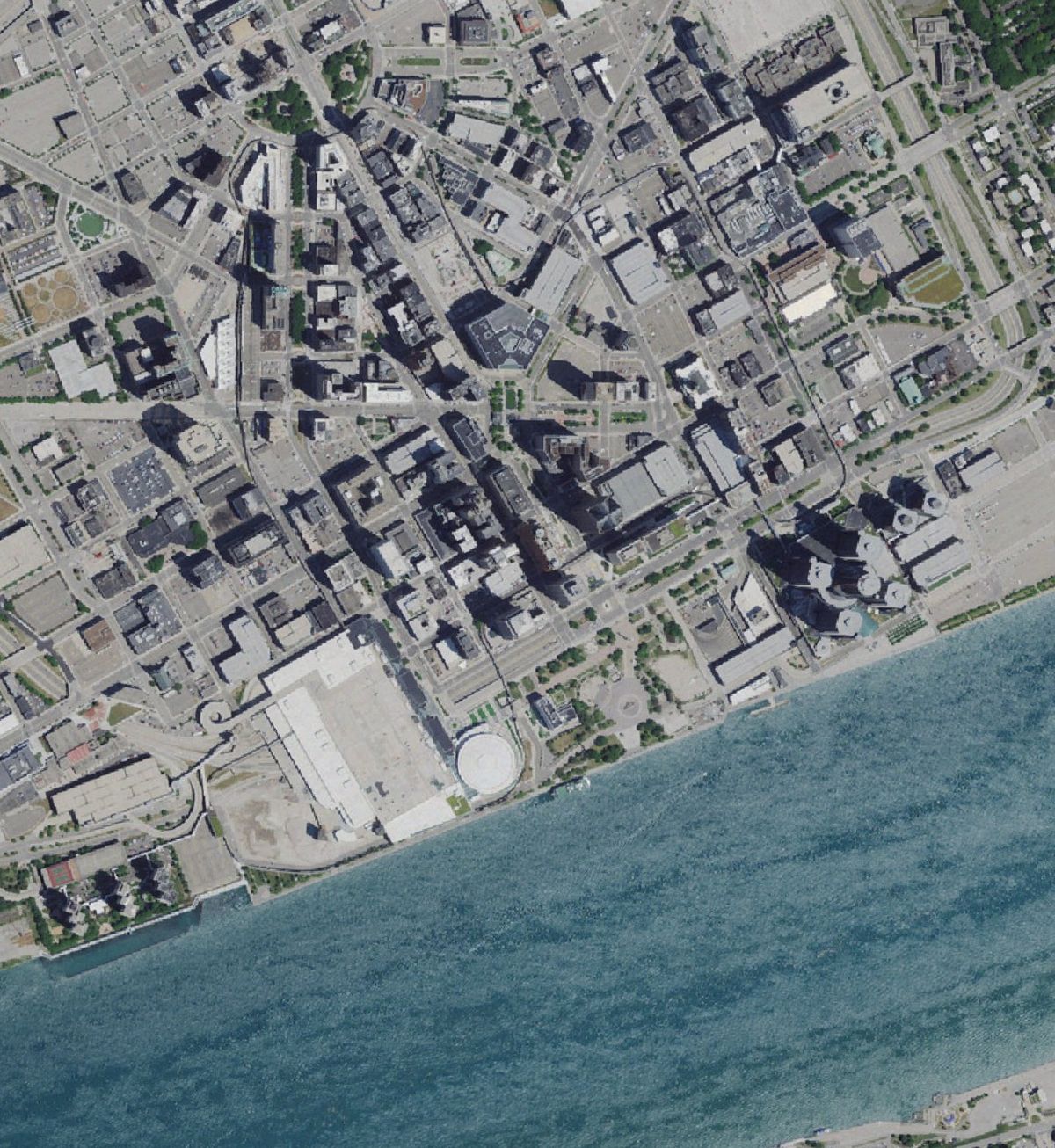
A real aerial photo of downtown with the guideway’s exact alignment on top. The green cars move according to the DTC’s official timetable, to the second. Click a station to open its page.

The Detroit People Mover loop on an aerial photo of downtown Detroit 1. Times SquareTimes Square2. Michigan AvenueMichigan Avenue3. Fort/CassFort/Cass4. Huntington PlaceHuntington Place5. Water SquareWater Square6. Financial DistrictFinancial District7. Millender CenterMillender Center8. Renaissance CenterRenaissance Center9. BricktownBricktown10. GreektownGreektown11. Cadillac CenterCadillac Center12. BroadwayBroadway13. Grand Circus ParkGrand Circus Park
Guideway (one way, counter-clockwise)Train, per timetableQLINE streetcar (Woodward Ave)Aerial photo: USGS The National Map / USDA NAIP (public domain). Street names and guideway: © OpenStreetMap contributors. Car positions: DTC GTFS timetable; the DTC publishes no live GPS feed.

03 / Virtual loop

Take the front seat

Thirteen stops in their real order. At each one we tell you what you see from the window, which artwork waits on the platform and what happened there over four decades. Press play and the car travels the map as well.

  1. Times Square station and the maintenance building (2023)
    42-BRT · CC BY-SA 4.0

    Stop 1 of 13

    Times Square

    The car leaves the trees of Grand Circus Park and turns west; the Book Tower’s crown appears, and below us the maintenance tracks branch off. Times Square is the People Mover’s home: the cars rest here overnight.

    Tom Phardel’s art deco Pewabic tiles and Anat Shiftan’s 1993 mural with the commemorative tiles from 1987.

    The station’s full story ↗
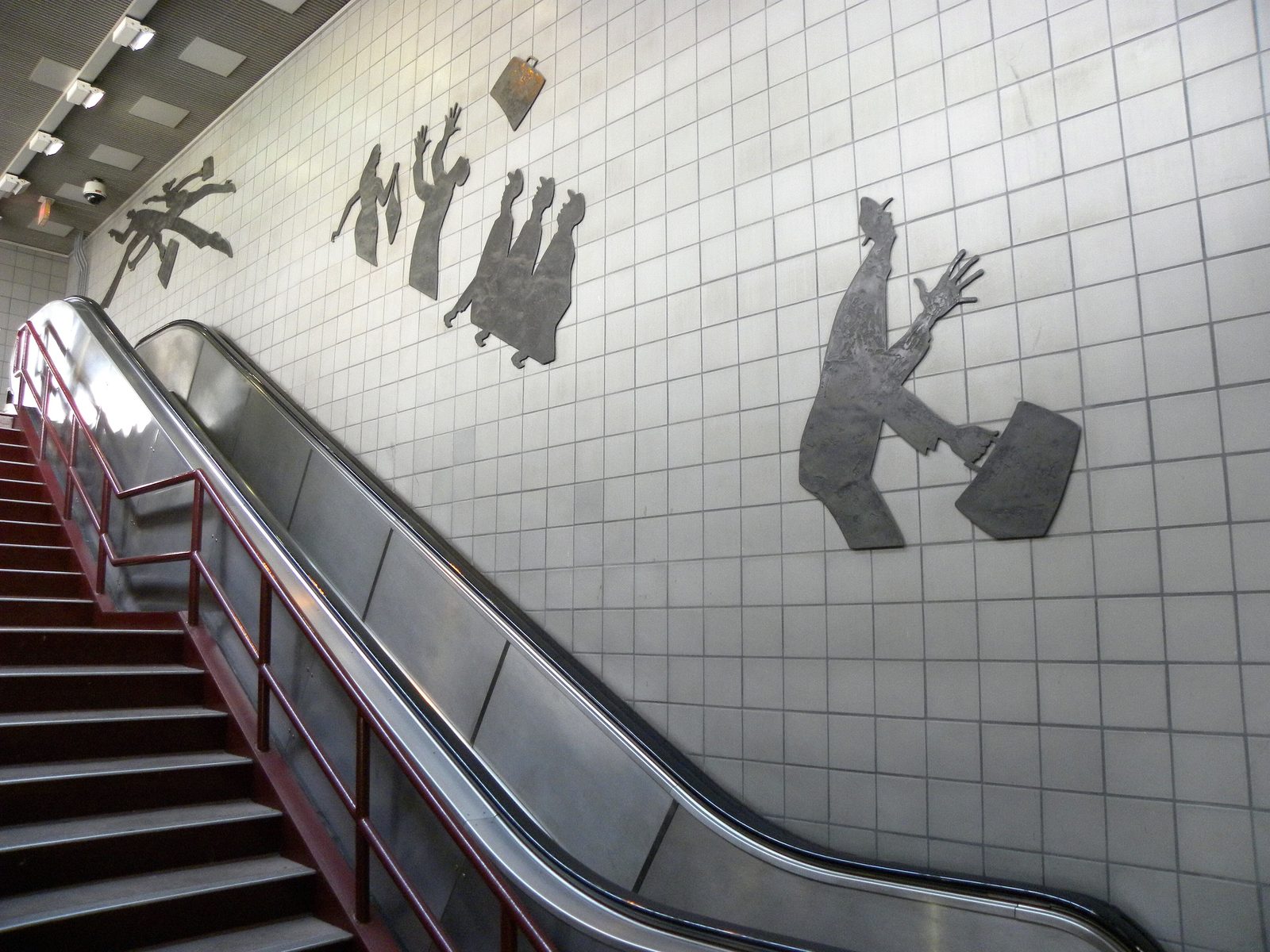
  2. A train at Michigan Avenue station, August 2025
    Michael Barera · CC BY-SA 4.0

    Stop 2 of 13

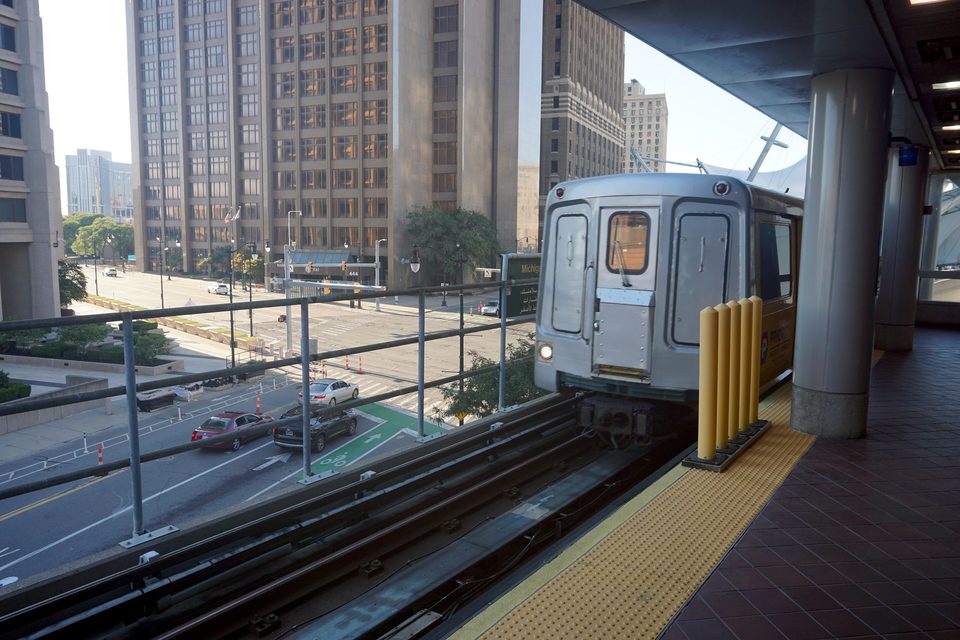
    Michigan Avenue

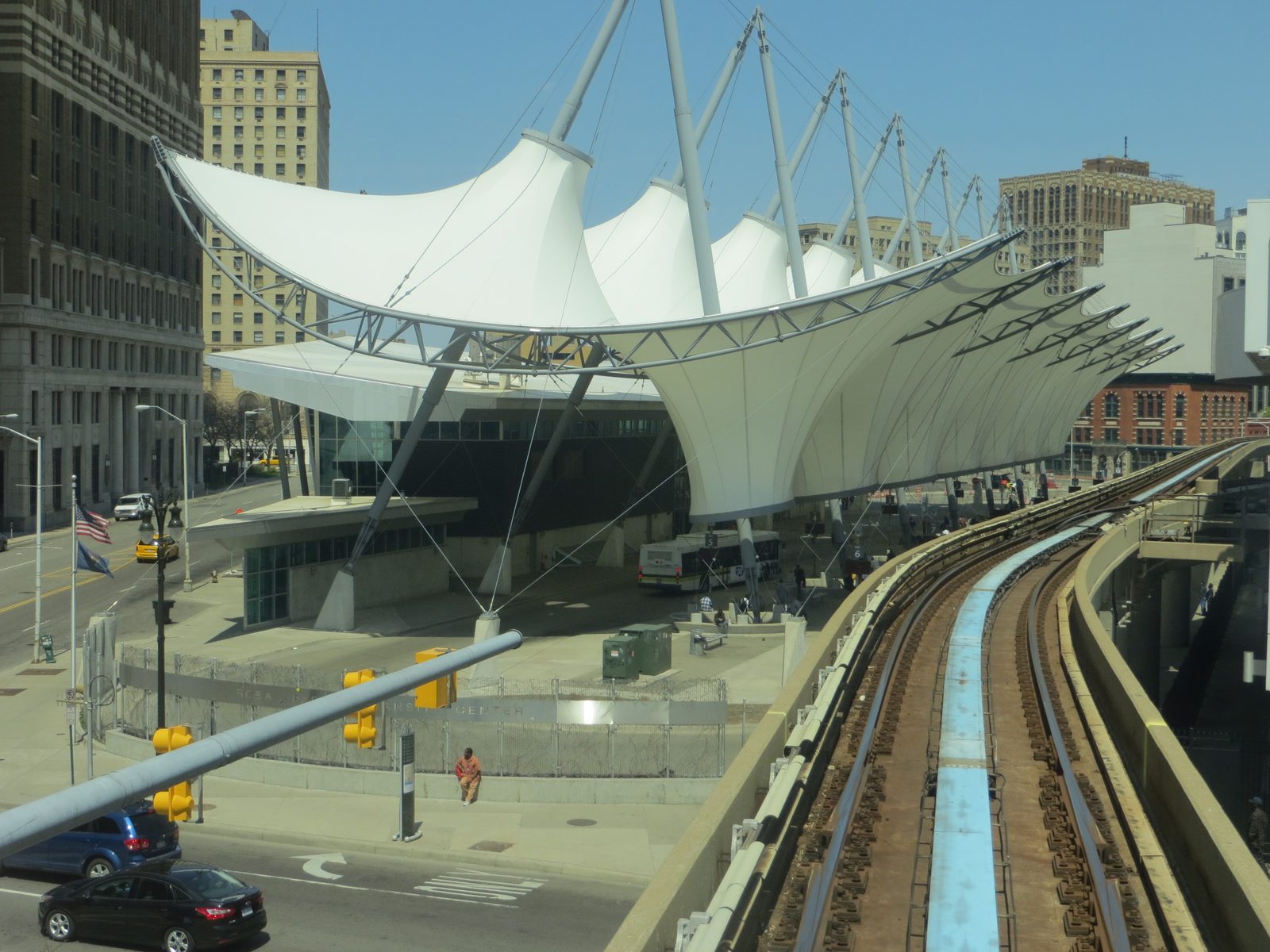
    A short hop south: the guideway crosses Michigan Avenue, old US 12 that once ran all the way to Chicago. Below, the Rosa Parks bus centre and the Coney Island diners of Detroit’s hot-dog rivalry.

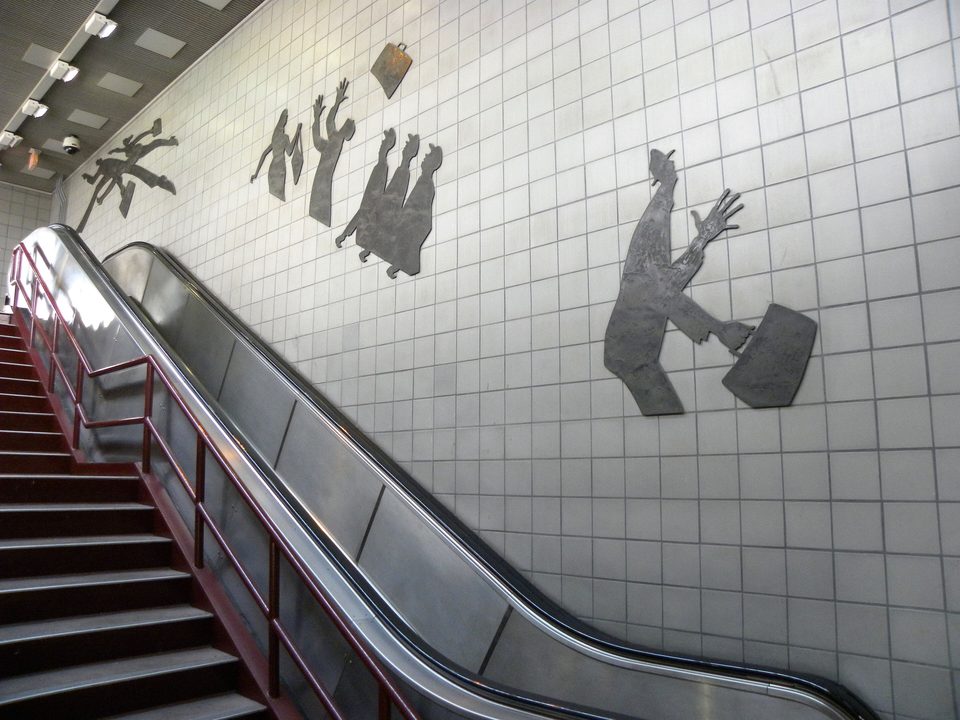
    Kirk Newman’s 14 bronze figures dash up the escalator, the largest 23 feet long; Allie McGhee’s tile “painting”.

    The station’s full story ↗
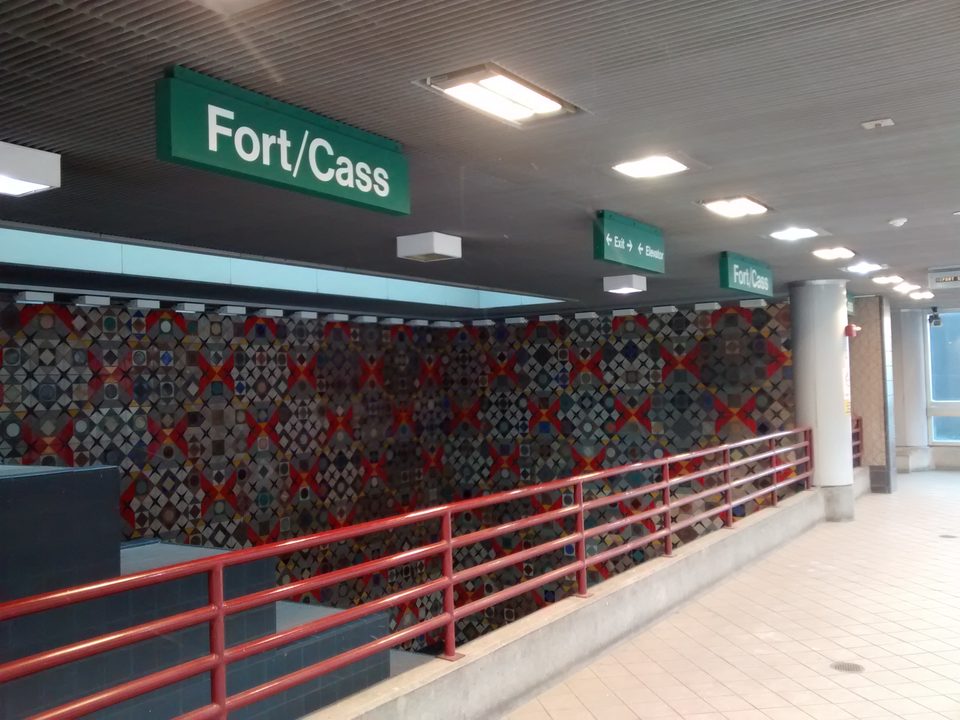
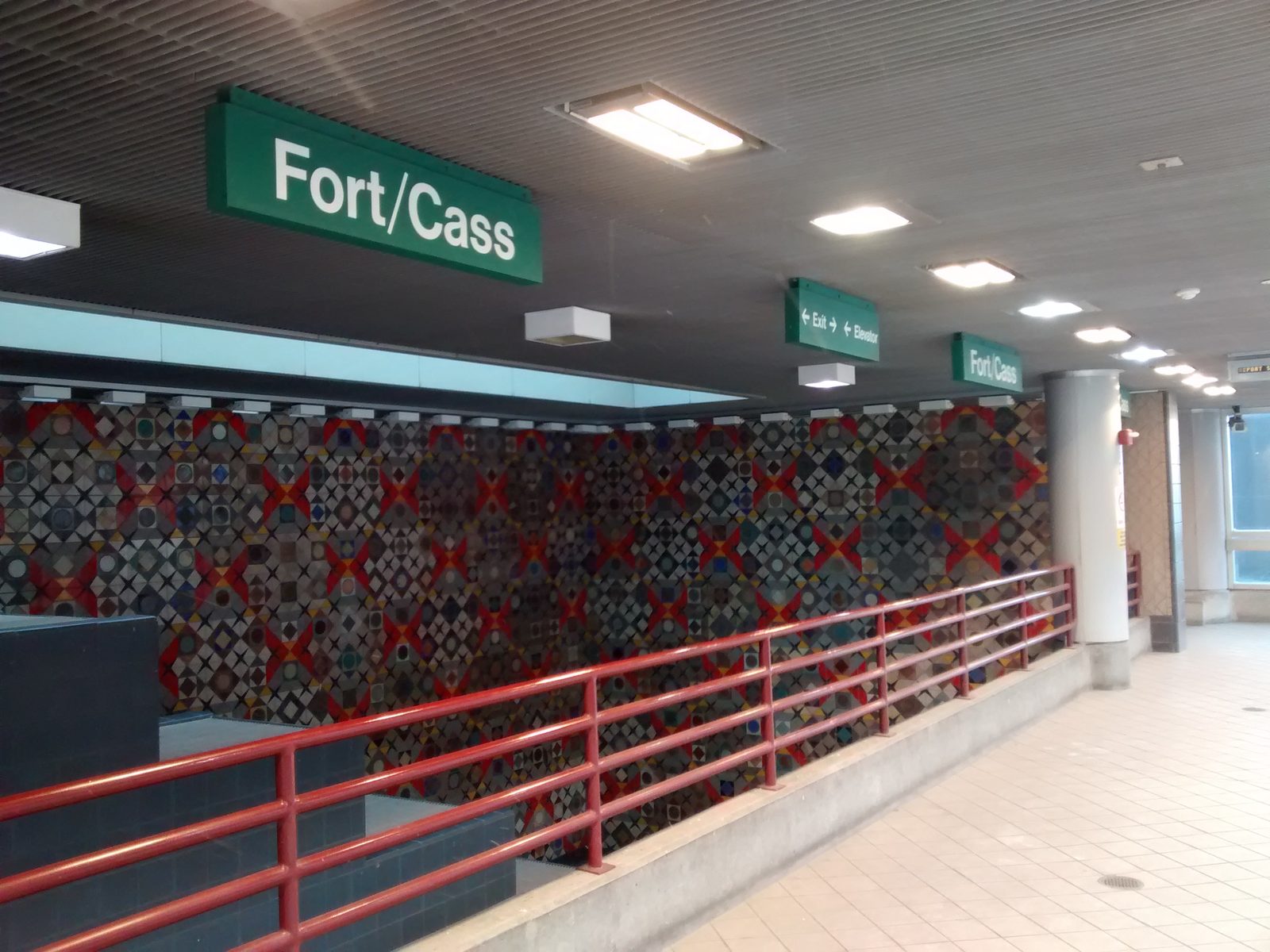
  3. The Fort/Cass platform with Farley Tobin’s patterned tile wall (2016)
    Mx. Granger · CC0

    Stop 3 of 13

    Fort/Cass

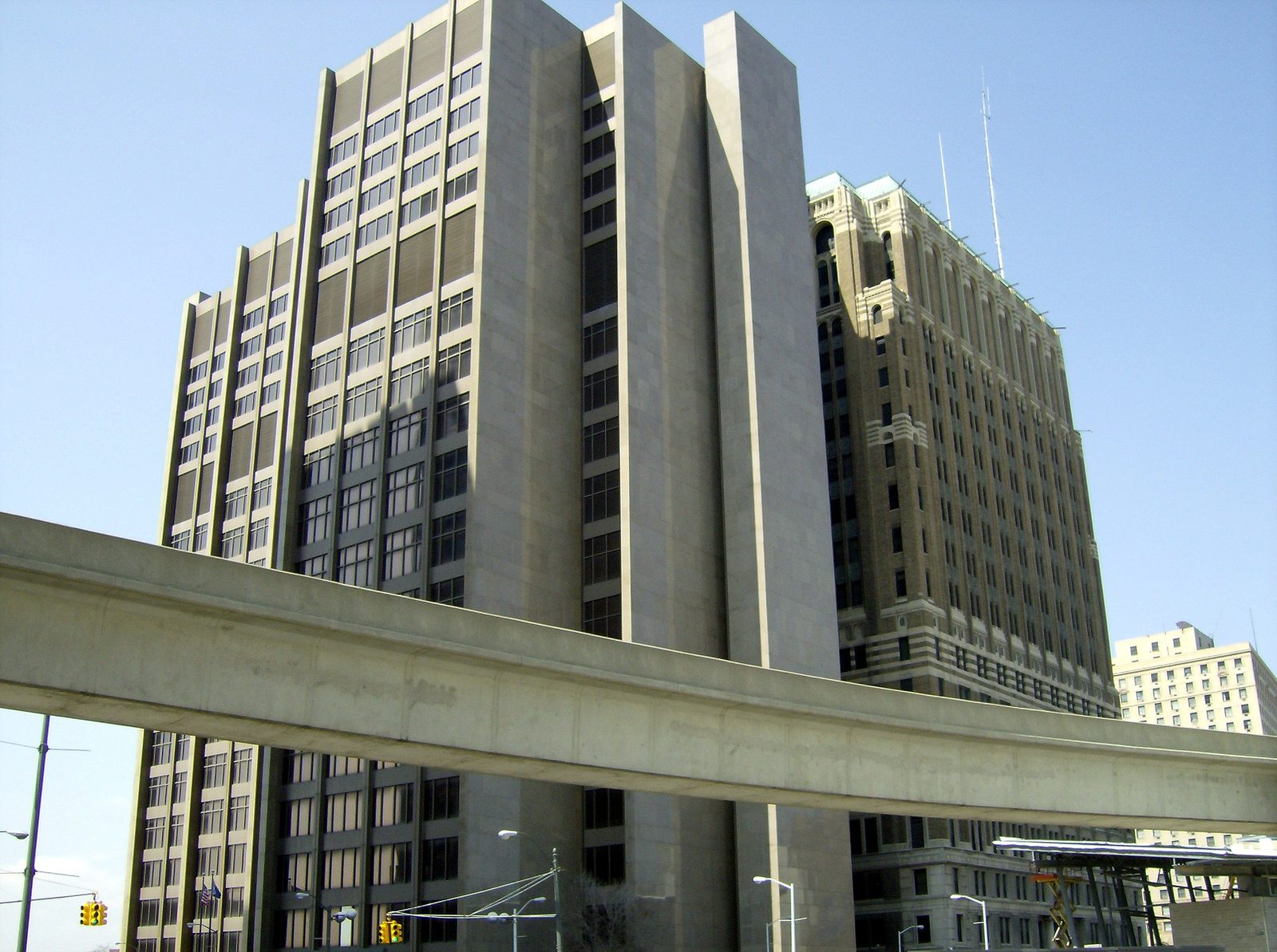
    The guideway runs south above Cass Avenue through the district of courts and old churches: Fort Street Presbyterian’s spire on one side, the federal courthouse block on the other.

    Farley Tobin’s 30,000-tile geometric mural, some glazes made with Mount St. Helens ash, and Sandra Jo Osip’s bronzes.

    The station’s full story ↗
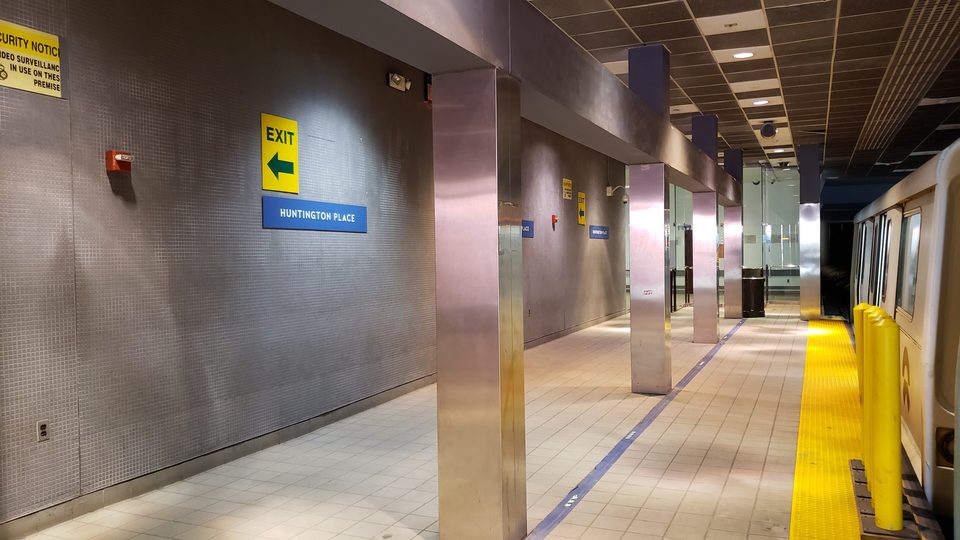
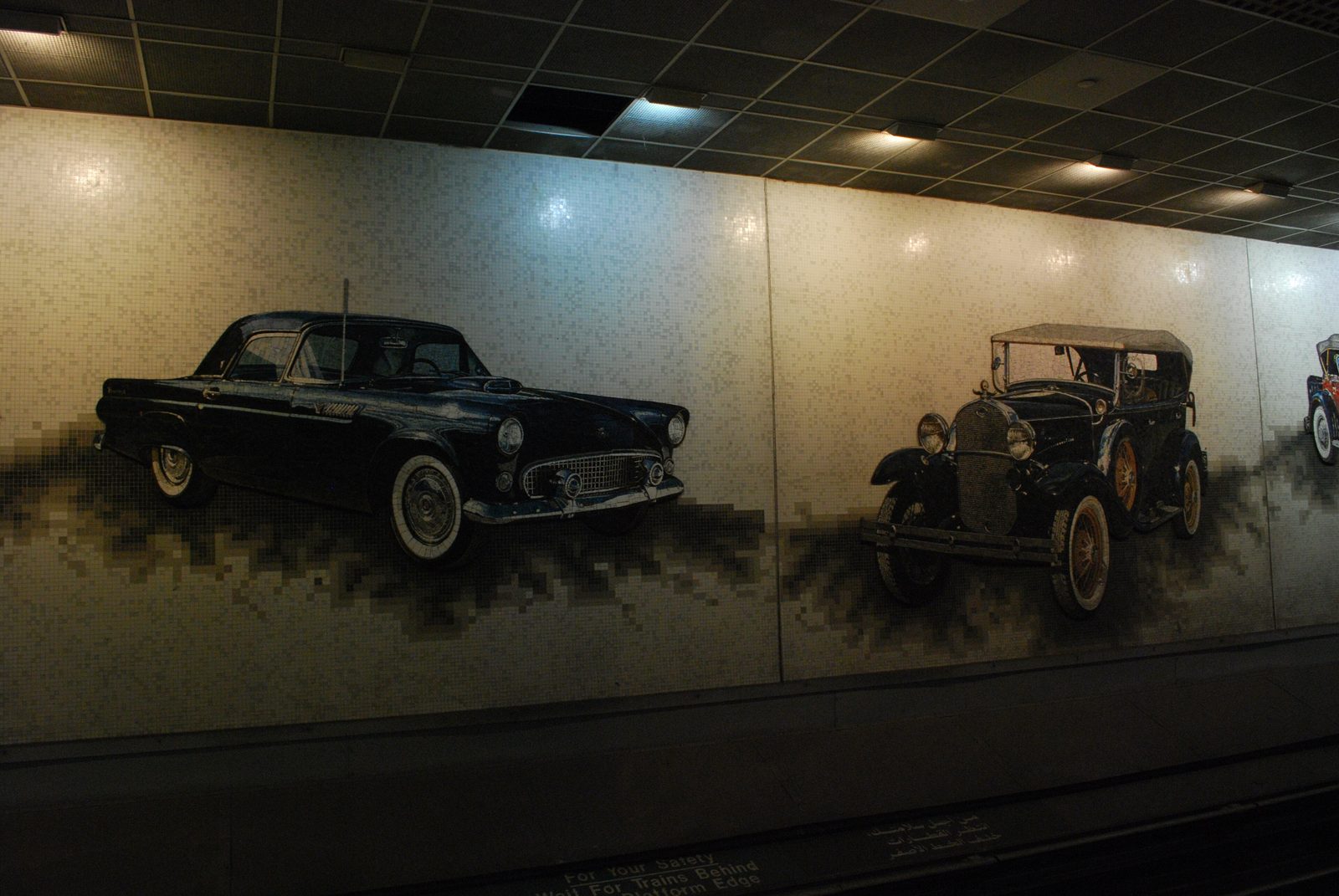
  4. The Huntington Place station platform (2022)
    42-BRT · CC BY-SA 4.0

    Stop 4 of 13

    Huntington Place

    Former names: Cobo Hall (1988–1989) · Cobo Center (1989–2019) · Convention Center (2019–2022)

    The car slips into the convention centre: the track runs on the third floor above the main hall, and during the auto show the crowds below can hear it pass. Seven vintage cars shine in Venetian glass on the station wall.

    “Cavalcade of Cars”: seven vintage cars in Venetian glass from Italy’s Crovatto studio.

    The station’s full story ↗
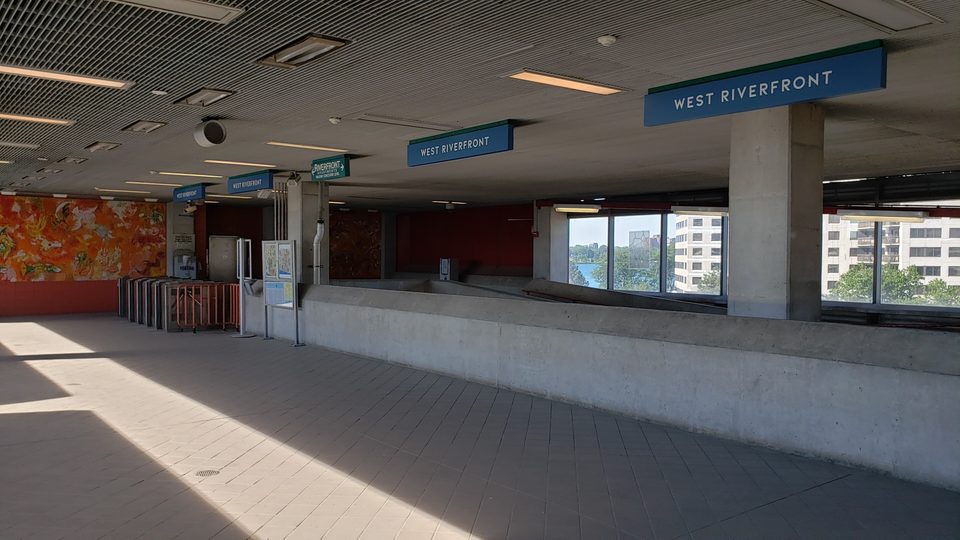
  5. Today’s Water Square station platform, then named West Riverfront (2022)
    42-BRT · CC BY-SA 4.0

    Stop 5 of 13

    Water Square

    Former names: Joe Louis Arena (1987–2022) · West Riverfront (2022–2025)

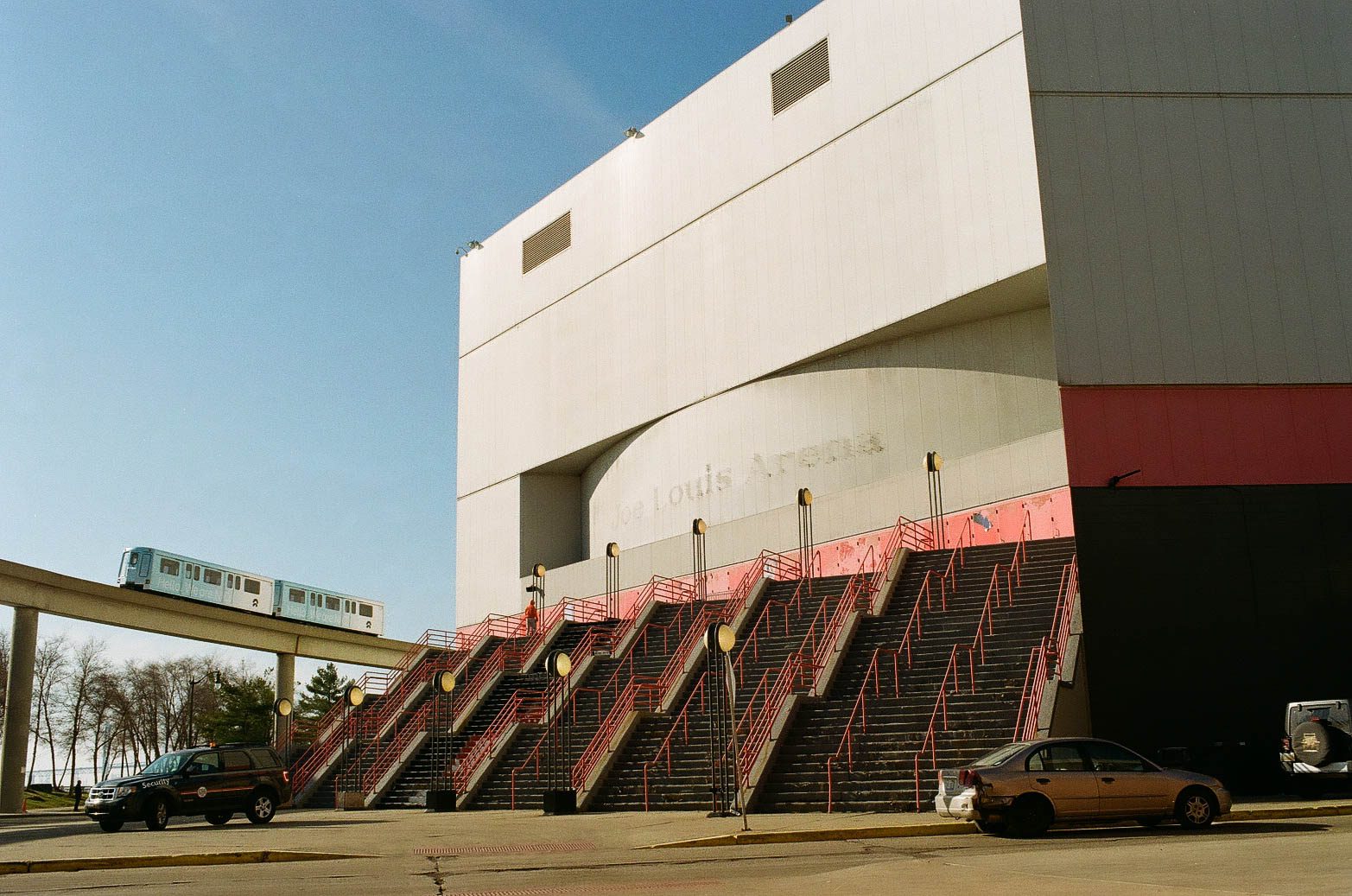
    The guideway swings onto the river: the Riverwalk below, Windsor across, and the arc of the Ambassador Bridge to the west. Where Joe Louis Arena, the Red Wings’ ice palace, stood until 2019, an apartment tower and a rising JW Marriott hotel now stand.

    Gerome Kamrowski’s Venetian glass “Voyage”, recoloured from blue to orange to match Joe Louis Arena.

    The station’s full story ↗
  6. Financial District station photographed down the track (2022)
    42-BRT · CC BY-SA 4.0

    Stop 6 of 13

    Financial District

    The loop’s longest leg: the car runs east along the riverfront, then turns north onto Larned Street. On one side the Guardian Building’s orange brick and Pewabic ornament, home of the DTC offices; on the other, glimpses toward Hart Plaza and the Spirit of Detroit.

    Joyce Kozloff’s three-storey ceramic mural: peacocks, bulls and bears that together form a giant “D”.

    The station’s full story ↗
  7. A train approaching Millender Center station (2022)
    42-BRT · CC BY-SA 4.0

    Stop 7 of 13

    Millender Center

    The car glides into the Millender Center at fifth-floor level. From the glass-walled platform you see the Coleman A. Young Municipal Center and the Renaissance Center towers, while below starts the tunnel to Windsor.

    Alvin Loving Jr.’s “Detroit New Morning”, 5,000 Pewabic tiles painted with brooms.

    The station’s full story ↗
  8. Renaissance Center station at the foot of the towers, with a train arriving (2025)
    42-BRT · CC BY-SA 4.0

    Stop 8 of 13

    Renaissance Center

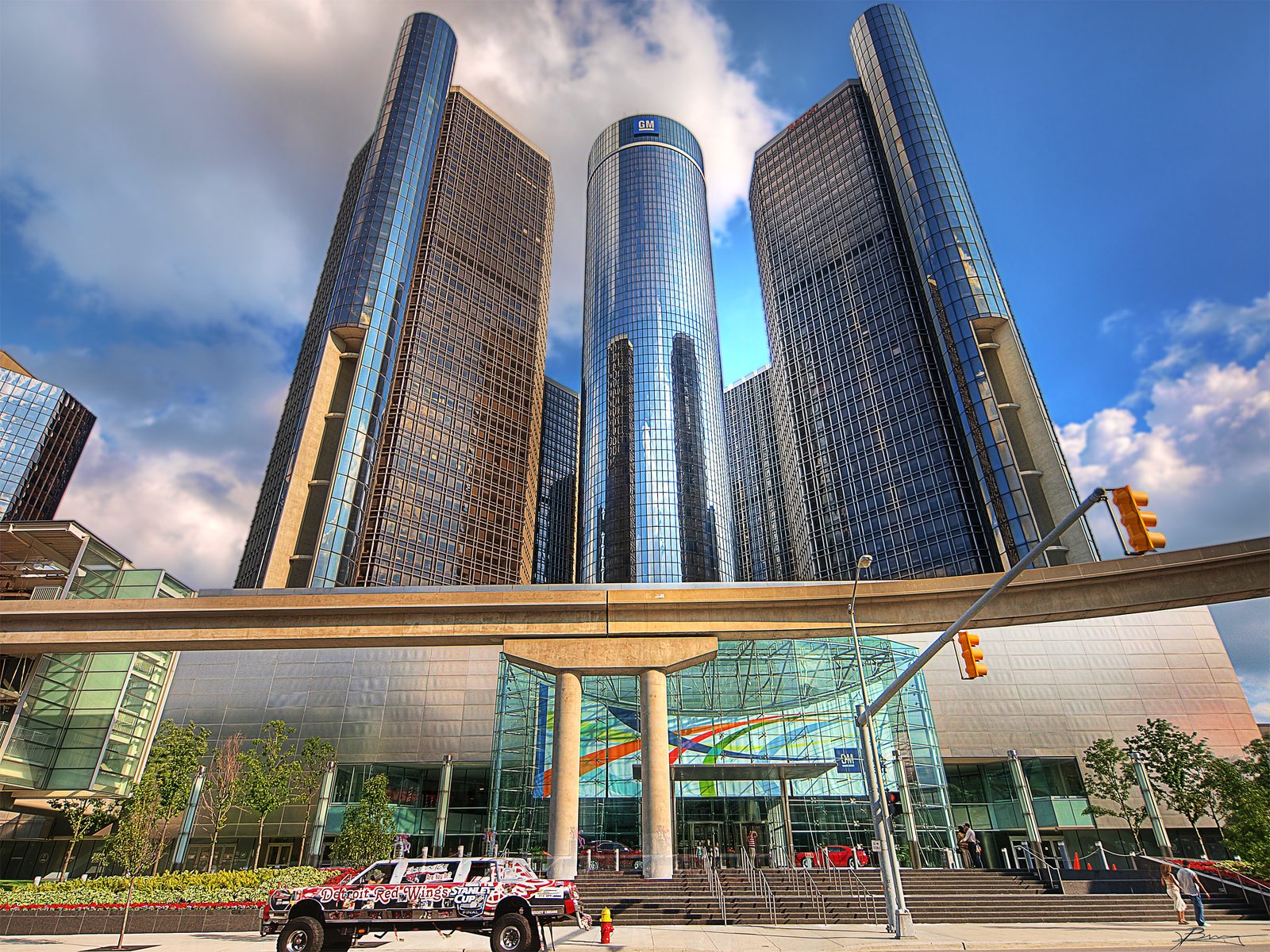
    A short hop over Jefferson Avenue and the Renaissance Center’s seven glass cylinders tower above: long the headquarters of General Motors, and “Tarryton Towers” in the film Real Steel.

    Marshall Fredericks’s bronze ram and George Woodman’s “Path Games”; the original Woodman work was destroyed in 2002.

    The station’s full story ↗
  9. A train entering Bricktown station, with the Renaissance Center behind
    Mikerussell · CC BY-SA 3.0

    Stop 9 of 13

    Bricktown

    Former names: Beaubien/Fort (planned) (1979)

    A climb north above Beaubien Street: the Wayne County Building on one side, the Blue Cross Blue Shield offices on the other, and below, the old brick district that gave the station its name.

    Glen Michaels’s “Beaubien Passage” relief and Anthony Lee’s 2024 mural “Detroit Music Love”.

    The station’s full story ↗
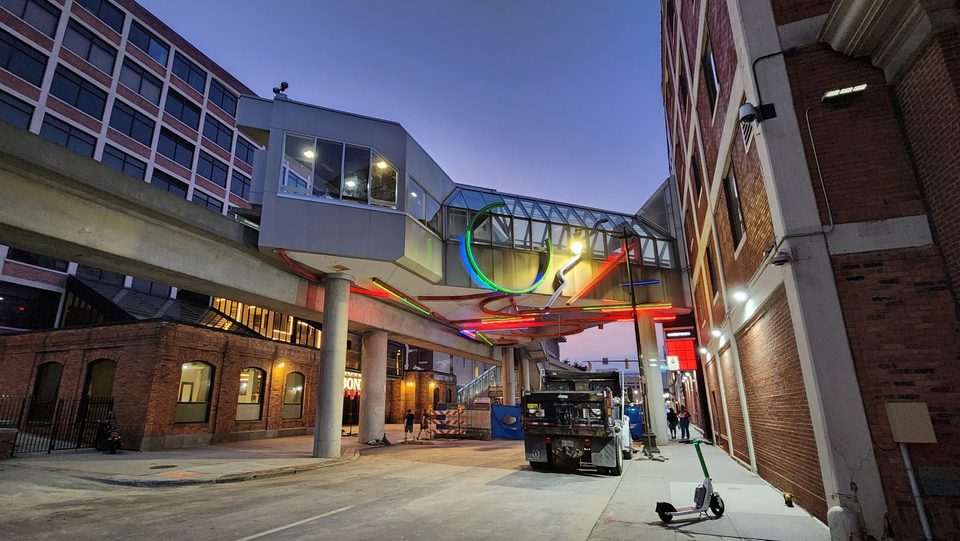
  10. Greektown station at dusk, with the street closed to traffic (2025)
    42-BRT · CC BY-SA 4.0

    Stop 10 of 13

    Greektown

    Former names: MetroPCS-Greektown (2011–2012)

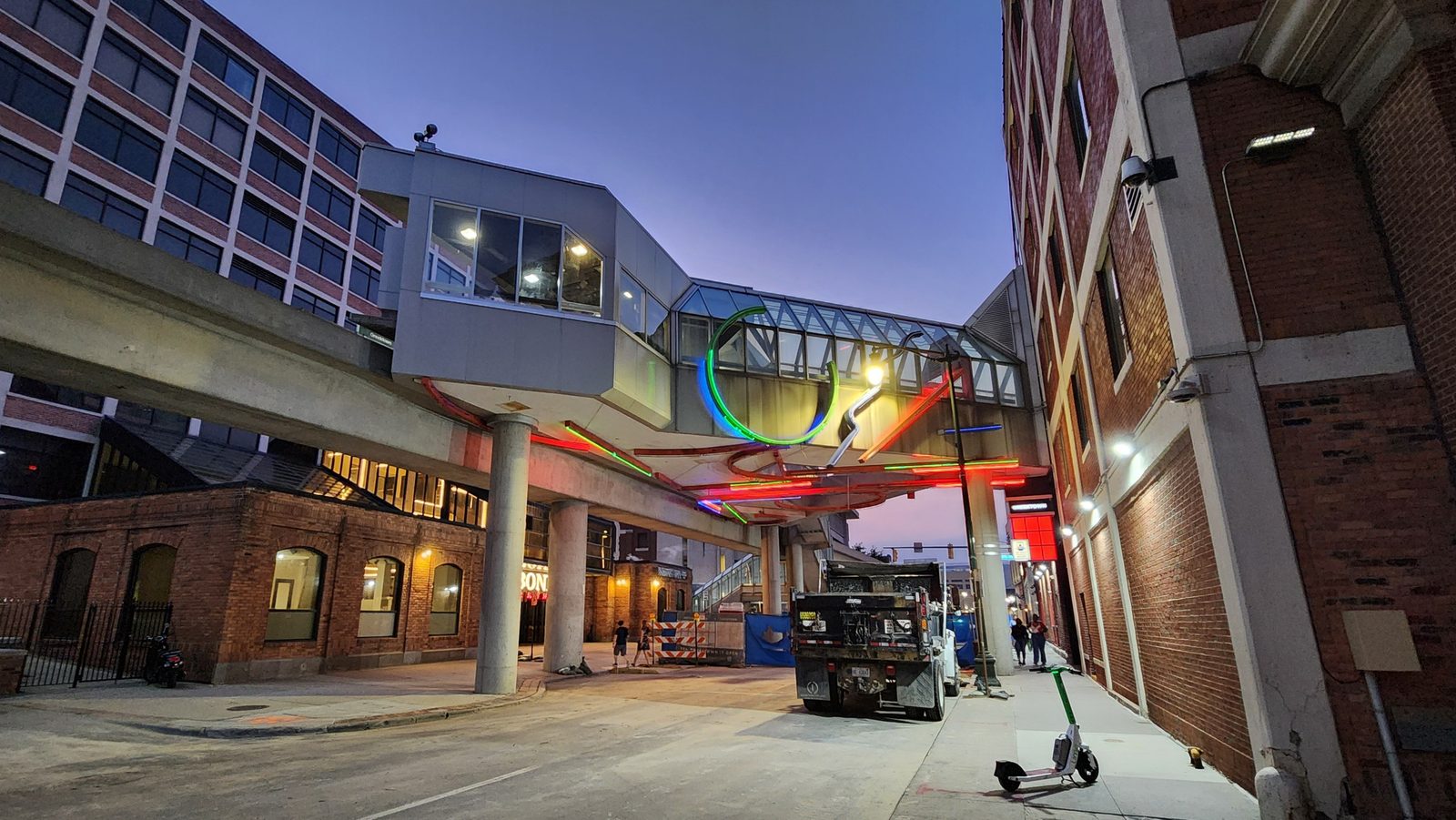
    The car reaches Monroe Street, where Stephen Antonakos’s neon sculpture glows on the station’s face. Below are the Greek restaurants, Trappers Alley and the Hollywood Casino, with Old St. Mary’s spire nearby.

    Stephen Antonakos’s neon sculpture, being remade for the 2027 Final Four.

    The station’s full story ↗
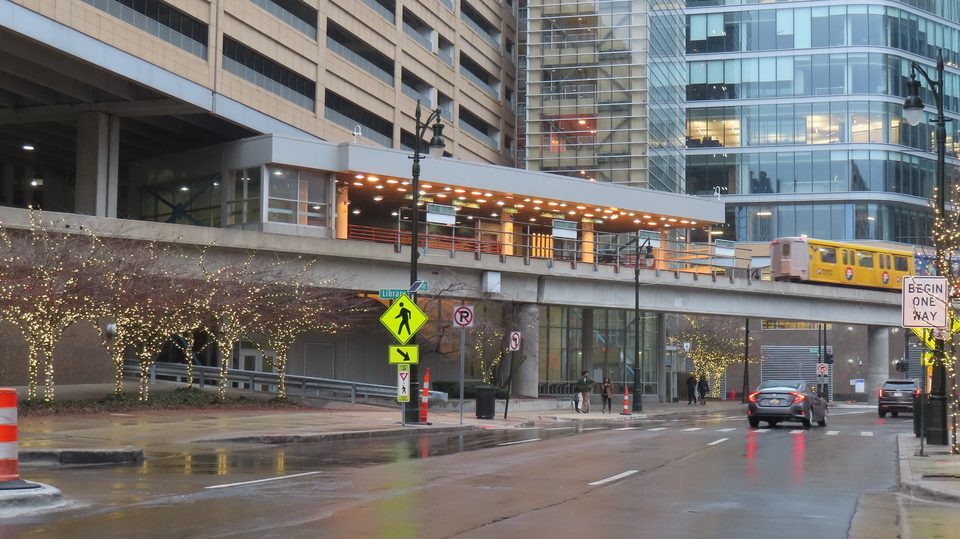
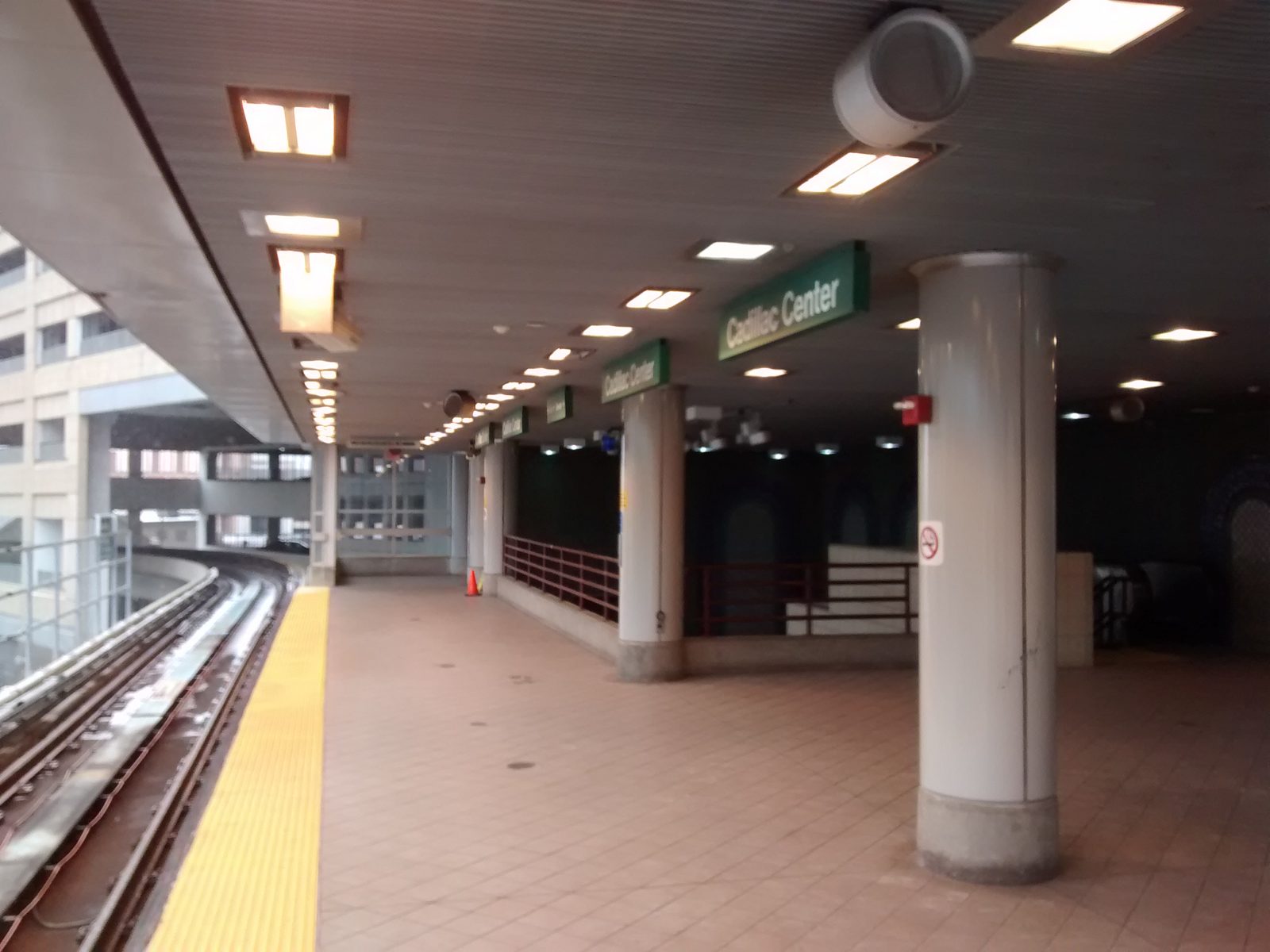
  11. Cadillac Center station with a train, built into the One Campus Martius garage (2024)
    42-BRT · CC BY-SA 4.0

    Stop 11 of 13

    Cadillac Center

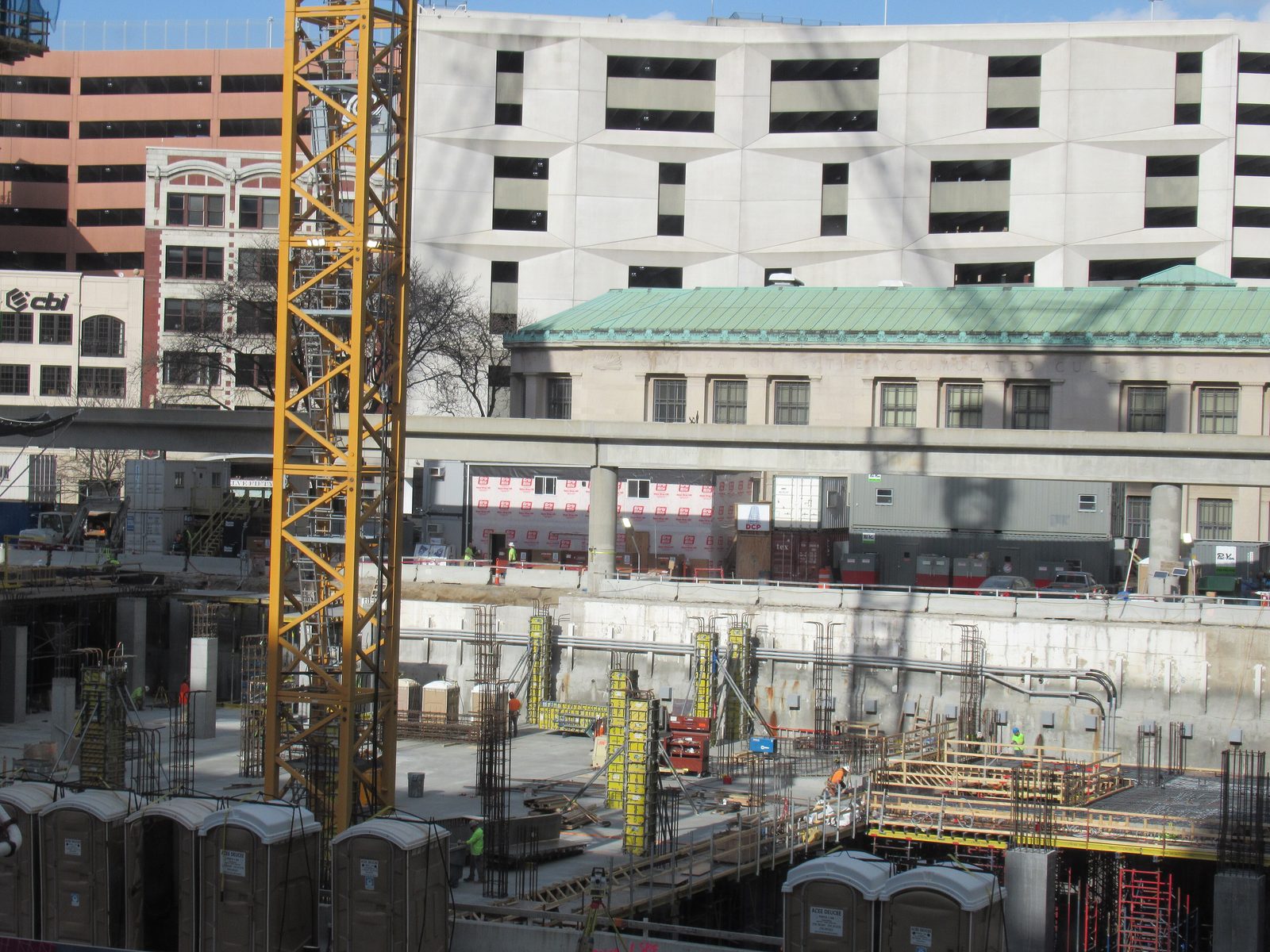
    The guideway turns west into a parking garage. A block away lies Campus Martius, downtown’s living room, beneath the new Hudson’s tower, on the site of the Hudson’s store whose 1998 implosion stopped the People Mover.

    Diana Pancioli’s Pewabic mosaic of 26,000 1930s tiles and Carlo Romanelli’s 1901 bronze.

    The station’s full story ↗
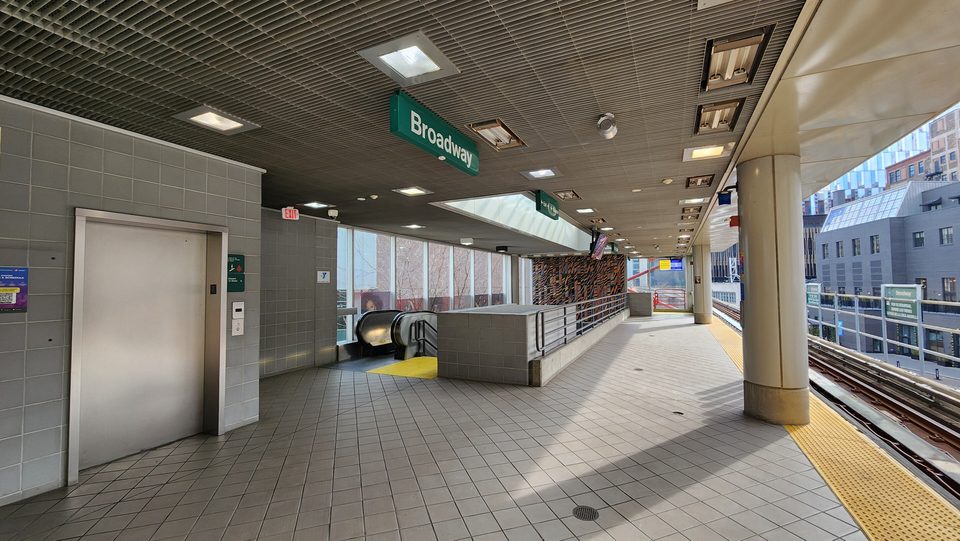
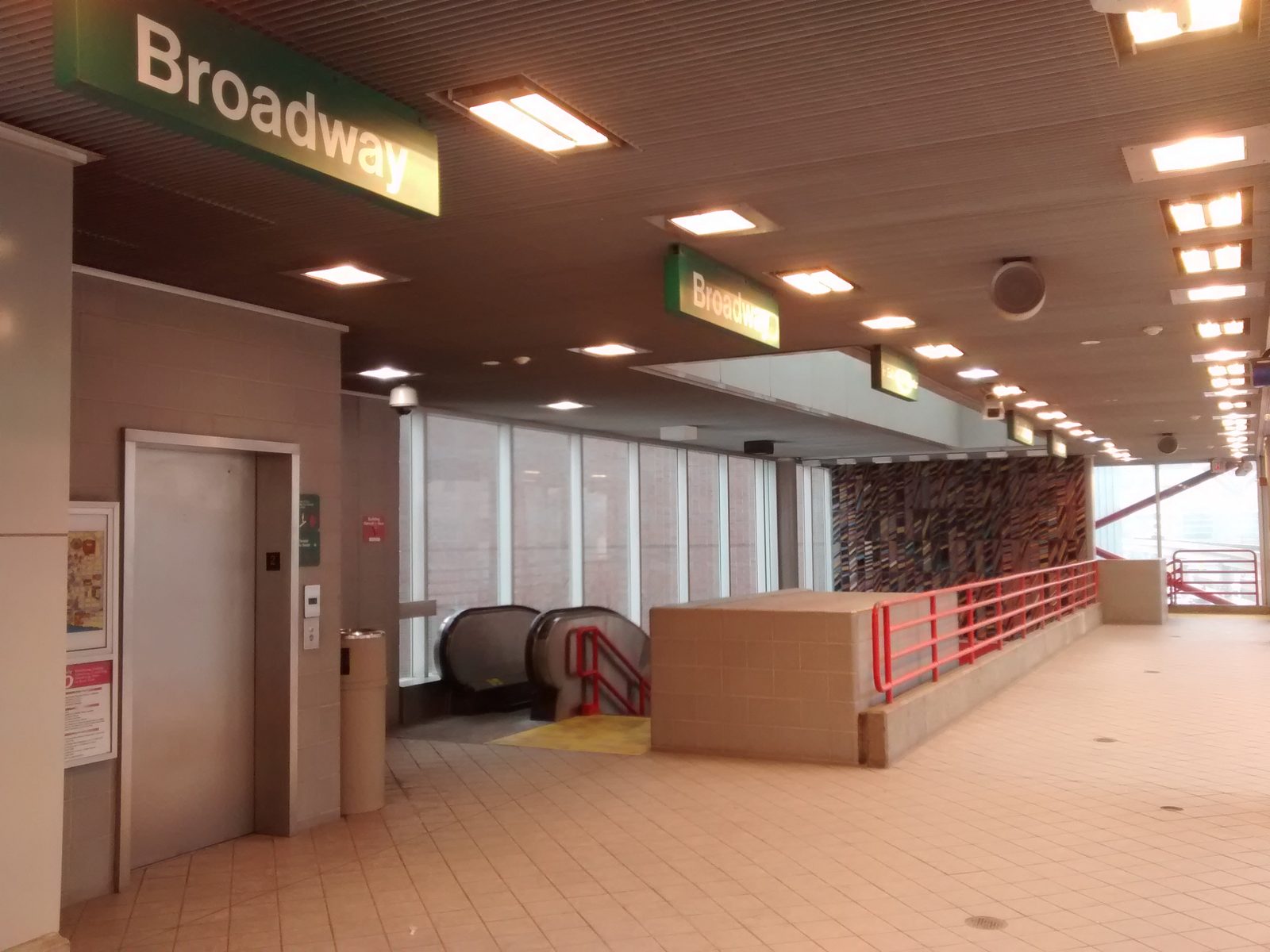
  12. The Broadway station platform (2025)
    42-BRT · CC BY-SA 4.0

    Stop 12 of 13

    Broadway

    North-west toward Broadway and John R Street, where the theatre district begins: Ford Field, home of the Lions, to the east; Comerica Park, home of the Tigers, to the north; the Detroit Opera House close by.

    Charles McGee’s “The Blue Nile”, Jun Kaneko’s tiles and Charles “Chazz” Miller’s 2024 mural.

    The station’s full story ↗
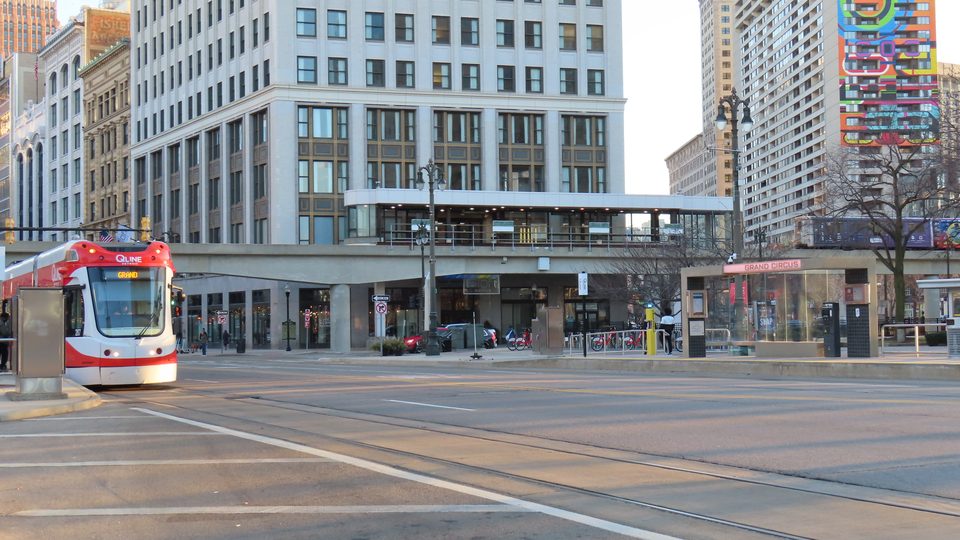
  13. Grand Circus Park: the People Mover above, the QLINE streetcar below (2023)
    42-BRT · CC BY-SA 4.0

    Stop 13 of 13

    Grand Circus Park

    The car arrives above the half-moon park of Grand Circus: the Fox Theatre’s marquee, Comerica Park and Little Caesars Arena to the north, the QLINE streetcar stopping below on Woodward Avenue. The station nestles into the 1915 David Whitney Building.

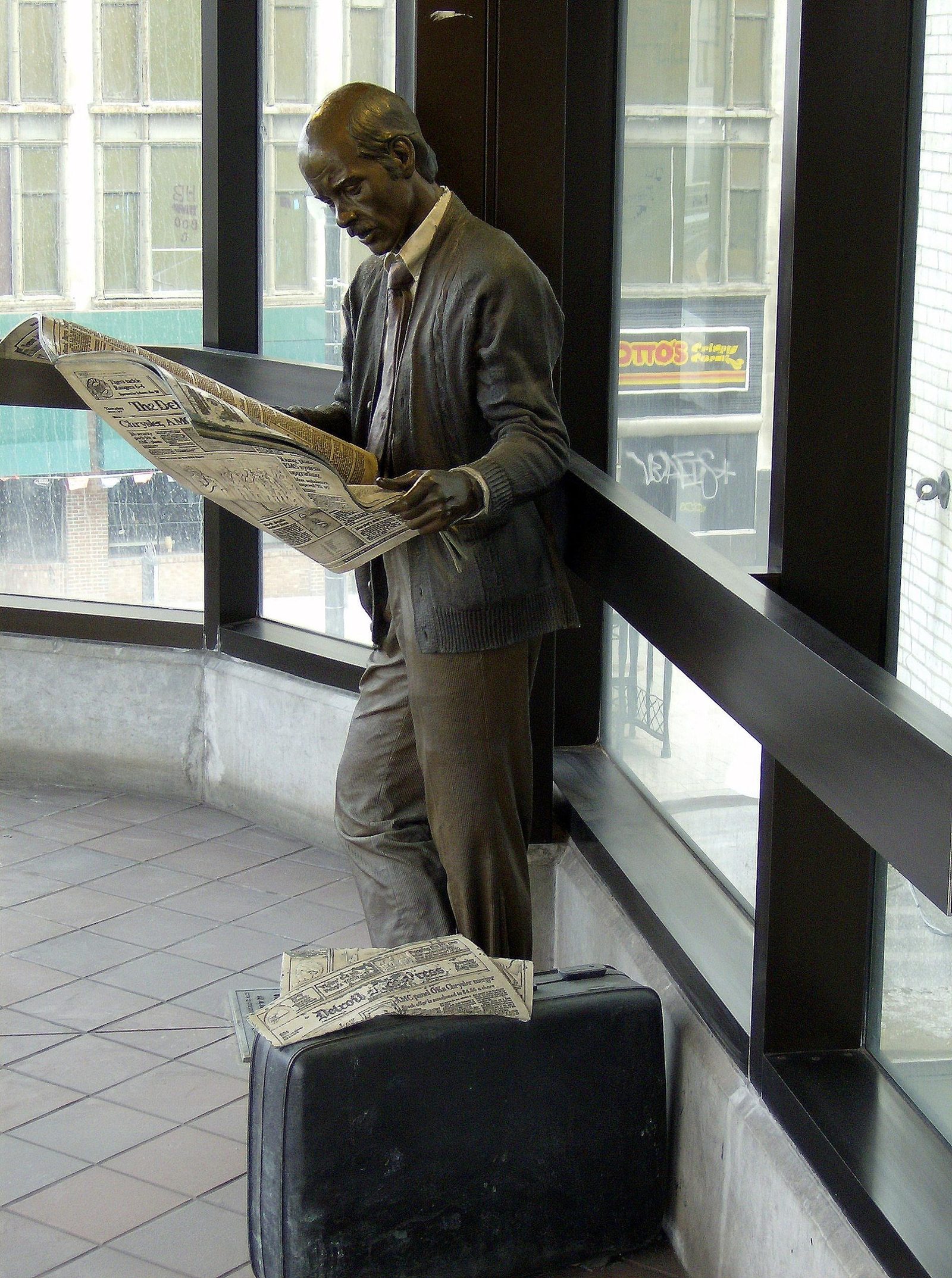
    J. Seward Johnson’s “Catching Up”: a bronze commuter with the May 21, 1987 Detroit News.

    The station’s full story ↗

Sounds are synthesised in your browser and play only after a click. With reduced motion there is no autoplay.

04 / Stations

The 13 stations, each an attraction

Every station has its own page among our Places: history, name changes, artworks, connections, entrances and what’s on nearby.

  1. Times Square

    At the garage gate: the cars sleep here, and the loop begins here.

  2. Michigan Avenue

    Bronze runners chase the train: Detroit’s funniest station.

  3. Fort/Cass

    Volcanic ash in the glaze and 30,000 tiles: the quietest station’s big secret.

  4. Huntington Place

    Former names: Cobo Hall · Cobo Center · Convention Center

    A train above the exhibition hall: the 13th station, added a year late.

  5. Water Square

    Former names: Joe Louis Arena · West Riverfront

    The Red Wings’ old gateway, now the station of a new riverfront district.

  6. Financial District

    Where the car-shaped cake was cut in 1987, and where a giant “D” hides.

  7. Millender Center

    A station on a building’s fifth floor, with a skybridge to the RenCen.

  8. Renaissance Center

    At the foot of the towers: the busiest station, demolished once already.

  9. Bricktown

    Former names: Beaubien/Fort (planned)

    Among brick buildings, with a mural of Aretha, Eminem and Big Sean.

  10. Greektown

    Former names: MetroPCS-Greektown

    Neon, a casino and Greek restaurants: for decades the busiest station.

  11. Cadillac Center

    Named after a mall that was never built, tiled for a brewery that was never built.

  12. Broadway

    The station of theatres and stadiums: the opera, Ford Field, Comerica Park.

  13. Grand Circus Park

    A bronze commuter reads his 1987 paper between the Fox Theatre and Comerica Park.

05 / Timeline

From the idea to today

From Detroit’s streetcars through Washington’s promises, the concrete scandals and the crowds of opening day to the fare-free era and the cars from Toronto. Every claim is sourced.

1863–1974

From streetcars to subway dreams

Detroit once ran on more than 550 miles of streetcar track. The last streetcar vanished in 1956, and for decades the city drew rapid-transit plans without building any.

  1. Horse-drawn streetcars arrive

    Detroit’s first horse-drawn streetcar line opens. Rail remains the backbone of city transit for 93 years; at its peak the network covers more than 550 miles of track.

    History of Transit in Southeast Michigan (City of Romulus) · Historic Detroit – Detroit People Mover

  2. The first subway idea

    According to a later TIME account, the Michigan legislature floated a Detroit subway as early as 1905. For the next eight decades Detroit kept planning rapid transit without building a single line.

    TIME, 1986 – Horizontal Elevator to Nowhere

  3. The last streetcar on Woodward

    Streetcar service ends after 93 years; buses take over Woodward Avenue. Rails return only in 2017 with the QLINE on the same avenue.

    History of Transit in Southeast Michigan (City of Romulus) · Historic Detroit – Detroit People Mover

  4. A 240-mile monorail dream

    The Detroit Rapid Transit Commission sketches a 240-mile regional monorail network. It stays on paper.

    Historic Detroit – Detroit People Mover · History of Transit in Southeast Michigan (City of Romulus)

  5. SEMTA is born

    Michigan’s Public Act 204 of 1967 creates the Southeastern Michigan Transportation Authority (SEMTA), the agency that will later launch the People Mover.

    History of Transit in Southeast Michigan (City of Romulus)

  6. The “1990 Plan”

    SEMTA’s proposal calls for eight heavy-rail lines (75 miles, 63 stations) plus automated people movers for downtown, the medical centre and Wayne State, Fairlane, Southfield and the airport. The downtown loop appears for the first time.

    Wikipedia – Detroit People Mover · Historic Detroit – Detroit People Mover

1975–1982

Washington promises money

A federal demonstration programme, a presidential promise of $600 million and a city government set on saving downtown. The People Mover was designed as the downtown distributor of a subway network that was never built.

  1. Coleman A. Young and the “downtown distributor”

    Coleman A. Young, Detroit’s first Black mayor (1974–1994), builds a downtown people mover into his transit plan. The loop was meant to distribute riders from a Woodward subway and suburban lines around downtown. The same year the federal UMTA launches its Downtown People Mover programme.

    Historic Detroit – Detroit People Mover · Wikipedia – Detroit People Mover

  2. A national competition opens

    UMTA announces the Downtown People Mover demonstration. 65 cities express interest and 38 submit proposals; the aim is to see whether a fully automated system can help revive America’s downtowns.

    UMTA, 1976-04-05 – Downtown People Mover program announced · GAO CED-80-98 (1980) – Downtown People Mover program · DTC – About / History of DPM

  3. Detroit’s first plan: 2.3 miles

    Detroit’s bid proposes a single-track, 2.3-mile loop with 11 stations, 7.5–9.8 million riders a year, at roughly $55 million.

    GAO CED-80-98 (1980) – Downtown People Mover program

  4. $600 million from Gerald Ford

    After a White House meeting President Gerald Ford approves, and Transportation Secretary William T. Coleman confirms by letter, a $600 million federal commitment to Detroit rapid transit. The condition: business must invest an equal amount along the routes. Henry Ford II and Max Fisher had already written in support. The presidential election was two weeks away.

    The New York Times, 1976-11-01 – Detroit to get funds for rapid transit · UMTA, 1976-12-22 – Patricelli levele Young polgármesternek / letter to Mayor Young

  5. Decision: Detroit may build

    Secretary Coleman selects Cleveland, Houston, Los Angeles and St. Paul; Detroit and Miami may proceed within their existing federal commitments. UMTA Administrator Robert Patricelli writes to Mayor Young confirming the decision in principle. In the end only Detroit and Miami actually built their systems.

    UMTA, 1976-12-22 – Patricelli levele Young polgármesternek / letter to Mayor Young · GAO CED-80-98 (1980) – Downtown People Mover program · Wikipedia – Detroit People Mover

  6. A “horizontal elevator”

    Transportation Secretary Brock Adams announces a $950,288 grant for engineering and the environmental impact study. The press release calls the system a “horizontal elevator” and expects more than 50,000 riders a day.

    UMTA 36-78, 1978-06-21 – Detroit DPM engineering grant

  7. The 13 stations take shape

    SEMTA’s “The People Mover” fixes the 13 stations: Arena, Cobo Hall, Fort/Cass, Michigan, Times Square, Grand Circus Park, Broadway, Cadillac Center, Greektown, Beaubien/Fort, Renaissance, Millender Center and Financial District. By opening day “Beaubien/Fort” had become Bricktown and “Arena” Joe Louis Arena.

    Historic Detroit – Detroit People Mover

  8. The GAO sounds a warning

    A GAO report finds the federal share of the nine planned people movers has grown to $675 million amid delays and cost growth. Cleveland withdrew in 1977 and Houston in 1979.

    GAO CED-80-98 (1980) – Downtown People Mover program

  9. The Reagan era: a halt

    Budget cuts under the new Reagan administration prompt UMTA to halt work by telegram. The $600 million pledge evaporates and the subway plan dies for good. Congress rescues the People Mover: in 1981–1982 only the Detroit and Miami projects survive.

    Historic Detroit – Detroit People Mover · Los Angeles Times, 1985-12-08 – People Mover in Detroit seen as transit disaster · TIME, 1986 – Horizontal Elevator to Nowhere

  10. A Canadian technology is chosen

    SEMTA selects Ontario’s Urban Transportation Development Corporation (UTDC) as system contractor, and UMTA authorises $8 million for initial work. The chosen ICTS technology drives driverless cars with linear induction motors.

    UPI, 1981-08-07 – Financial News Briefs (UTDC & SEMTA) · Wikipedia – Detroit People Mover

  11. A car plant in Kingston

    UTDC and Ottawa’s TIW Industries form a joint venture to build cars in Kingston, Ontario, for Vancouver, Toronto’s Scarborough line and Detroit.

    UPI, 1981-11-10 – UTDC/TIW vehicle plant in Kingston

  12. The contract is signed

    Ontario Premier William Davis announces that the UTDC–SEMTA contract was signed that morning: a 4.6-km loop and 13 vehicles for about $110 million, to be in service by late 1985.

    UPI, 1982-04-23 – UTDC–SEMTA contract signed

1983–1987

Concrete, scandals, demolition

A groundbreaking on Halloween morning, cracked beams, a runaway budget and nicknames like “the train to nowhere”. Meanwhile a volunteer commission turned the 13 stations into a museum.

  1. Young’s fury

    Mayor Young complains to the Free Press that the money goes not to Detroit but to SEMTA, “sitting out in Oakland County some place designing a Detroit subway.”

    Historic Detroit – Detroit People Mover

  2. $45 million released

    The Reagan administration releases $45 million for People Mover construction.

    Historic Detroit – Detroit People Mover

  3. Groundbreaking on Halloween morning

    Ceremonial groundbreaking with a $137.5 million budget. The DTC’s official history says work had begun under SEMTA in spring 1983. Construction started when only 3.6 percent of the engineering was complete.

    The New York Times, 1987-08-01 – Years late, Detroit’s monorail opens · UPI, 1987-07-30 – People Mover opens Friday · DTC – About / History of DPM · Los Angeles Times, 1985-12-08 – People Mover in Detroit seen as transit disaster

  4. The art commission forms

    At Mayor Young’s request Irene Walt organises a volunteer committee to put art in every station. The Detroit People Mover Art Commission raises $2 million, engages 15 artists and delivers 18 new works, plus a 1903 bronze relief.

    Historic Detroit – Detroit People Mover · Wikipedia – Detroit People Mover · Crain’s Detroit Business, 2015-08-04 – Irene Walt dies at 91

  5. Elizabeth Dole steps in

    Transportation Secretary Elizabeth Dole announces the federal government will fund part of the overrun.

    UPI, 1984-09-24 – Elizabeth Dole on the cost overrun

  6. A protruding rod, faulty beams

    An inspector notices a steel rod protruding from a guideway beam. Of some 170 beams, 32 must be replaced and 36 strengthened; the cost jumps to $183 million, and UMTA will not match anything above $137 million.

    The New York Times, 1984-11-23 – Flaws slowing People Mover project · Fifth Estate #320 (1985) – Detroit’s People Mover

  7. The DTC is created

    The City of Detroit creates the Detroit Transportation Corporation (DTC), which takes the project over from SEMTA on October 4. Federal officials had ordered the city to take charge earlier in 1985.

    DTC – About / History of DPM · Wikipedia – Detroit People Mover · The New York Times, 1987-08-01 – Years late, Detroit’s monorail opens

  8. “The train to nowhere”

    The Los Angeles Times calls the project a transit disaster and quotes the nicknames: “train to nowhere”, “mugger mover”, “downtown bobsled run”. Costs reach $210 million and opening slips to spring 1987.

    Los Angeles Times, 1985-12-08 – People Mover in Detroit seen as transit disaster

  9. Twelve cars roll out in Kingston

    UTDC builds the 12 ICTS Mark I cars in Kingston. TIME runs “Horizontal Elevator to Nowhere”; UMTA chief Ralph Stanley calls it possibly “the nation’s least cost-effective transit project in the last 20 years”.

    Wikipedia – Detroit People Mover · TIME, 1986 – Horizontal Elevator to Nowhere

  10. A newspaper cast in bronze

    That day’s Detroit News headlines the Chrysler–American Motors merger. It is this issue that ended up in the hands of J. Seward Johnson’s “Catching Up” on the Grand Circus Park platform; legend says the News beat the Free Press on a coin toss.

    Wikipedia – Detroit People Mover

1987–1988

The first loop

A cake shaped like a car, ten thousand balloons, packed trains and a 50-cent fare. The 13th station opened a year later in the convention centre.

  1. Opening day

    The dedication takes place at Financial District station. Coleman Young and Max Fisher cut a five-foot cake shaped like a People Mover car; the first train breaks a green ribbon as 10,000 car-shaped balloons rise and a block party fills Larned Street. The public rides free from 1:30 p.m. to midnight. Construction cost $200.3 million, 80 percent federal.

    Wikipedia – Detroit People Mover · UPI, 1987-07-30 – People Mover opens Friday · The New York Times, 1987-08-01 – Years late, Detroit’s monorail opens

  2. Full trains, twenty-minute queues

    Opening-weekend trains run at crush load, with 20-minute waits at some stations and around 2,000 riders an hour; staff ask people to take just one loop. One rider tells the New York Times it is “better than the New York subways”.

    Wikipedia – Detroit People Mover · The New York Times, 1987-08-01 – Years late, Detroit’s monorail opens

  3. The 50-cent fare begins

    After a free week the fare becomes 50 cents. The first timetable: 7 a.m.–11 p.m. Monday to Thursday, 7 a.m.–midnight Friday, 9 a.m.–midnight Saturday, noon–8 p.m. Sunday. Every station had an armed guard, voice monitoring and a panic button.

    Wikipedia – Detroit People Mover · UPI, 1987-07-30 – People Mover opens Friday · The New York Times, 1987-08-01 – Years late, Detroit’s monorail opens

  4. First-year numbers

    Year one averaged 11,000–14,000 riders a day against projections of 67,000–71,000 weekday riders by 1990; the one-day record was 54,648. The Detroit News reported a best month of 13,207 daily rides against an expected 16,500.

    Wikipedia – Detroit People Mover · AECOM/DTC – Existing Conditions Assessment (2025-12-10) · Mackinac Center, 2007 – “a rich folks’ roller coaster”

  5. South African steel in the railings

    Controversy erupts when it emerges that steel piping from apartheid-era South Africa was used in the guardrails. The DTC is then led by Dorothy Brodie.

    Wikipedia – Detroit People Mover

  6. The 13th station opens

    Cobo Hall station opens last, as an infill station inside the expanded convention centre. The track runs above the main exhibition hall, and passing trains can be heard on the show floor. On November 18 the DTC takes over operations from UTDC.

    Wikipedia – Detroit People Mover

1989–2019

Thirty years above downtown

The Hudson’s implosion, casino and tower construction, changes of direction, a Super Bowl, records and tragedy. The People Mover declined and revived along with downtown.

  1. A film about the art

    The 30-minute documentary “Art in the Stations” by Sue Marx and Pamela Conn, who won an Academy Award for the short documentary “Young at Heart”, premieres at the Detroit Institute of Arts. Cobo Hall station becomes Cobo Center.

    Wikipedia – Detroit People Mover · Art in the Stations: Detroit People Mover (1988) – YouTube

  2. A derailment at Cadillac Center

    A train derails at Cadillac Center after a manhole cover falls onto the track.

    Wikipedia – Detroit People Mover

  3. New artworks

    Three new works arrive: Sandra Jo Osip’s bronze “Progression II” at Fort/Cass, Marshall Fredericks’s “Siberian Ram” at the Renaissance Center and Anat Shiftan’s Pewabic tile mural at Times Square.

    Wikipedia – Detroit People Mover

  4. The Hudson’s store is imploded

    The former J. L. Hudson’s department store, once one of the tallest in the world, is imploded. Debris damages the nearby guideway and the People Mover shuts down.

    Wikipedia – Detroit People Mover

  5. A red line and a green line

    Limited service resumes as two shuttles: a “red line” between Times Square and Millender Center and a “green line” between Greektown and Cobo Center. By November the loop is whole again and Times Square reopens.

    Wikipedia – Detroit People Mover

  6. A casino and a shuttered palace

    Greektown station reopens in January 2000 after the casino is completed; Grand Circus Park, closed because of the shuttered David Whitney Building, follows in April 2001, restoring the whole system.

    Wikipedia – Detroit People Mover

  7. The Renaissance Center station is demolished

    To open the Renaissance Center up to the city, the original station and the concrete berms around the complex are demolished, destroying George Woodman’s tile mural “Dreamers and Voyagers Come to Detroit”. With a gap in the track, service is limited: 2003 ridership was just 157,697.

    Wikipedia – Detroit People Mover · Woodman Family Foundation – Dreamers and Voyagers Come to Detroit · FTA National Transit Database – DTC (50141) monthly ridership

  8. The loop closes again

    The new track opens; the new Renaissance Center station, with George Woodman’s new mural “Path Games”, opens on November 22 according to the DTC. The same year Irene Walt publishes the book “Art in the Stations” with photographs by Balthazar Korab.

    Wikipedia – Detroit People Mover · DTC – About / History of DPM

  9. Super Bowl XL

    Over five days around the Super Bowl the People Mover carries 215,910 riders. January 2006, with 399,032 rides, remains the busiest month in the federal record that starts in 2002.
    Wikipedia – Detroit People Mover · FTA National Transit Database – DTC (50141) monthly ridership

  10. Mid-life overhaul

    The 12 cars get a full mid-life overhaul, and the train-control system is rebuilt before 2010.

    AECOM/DTC – Existing Conditions Assessment (2025-12-10)

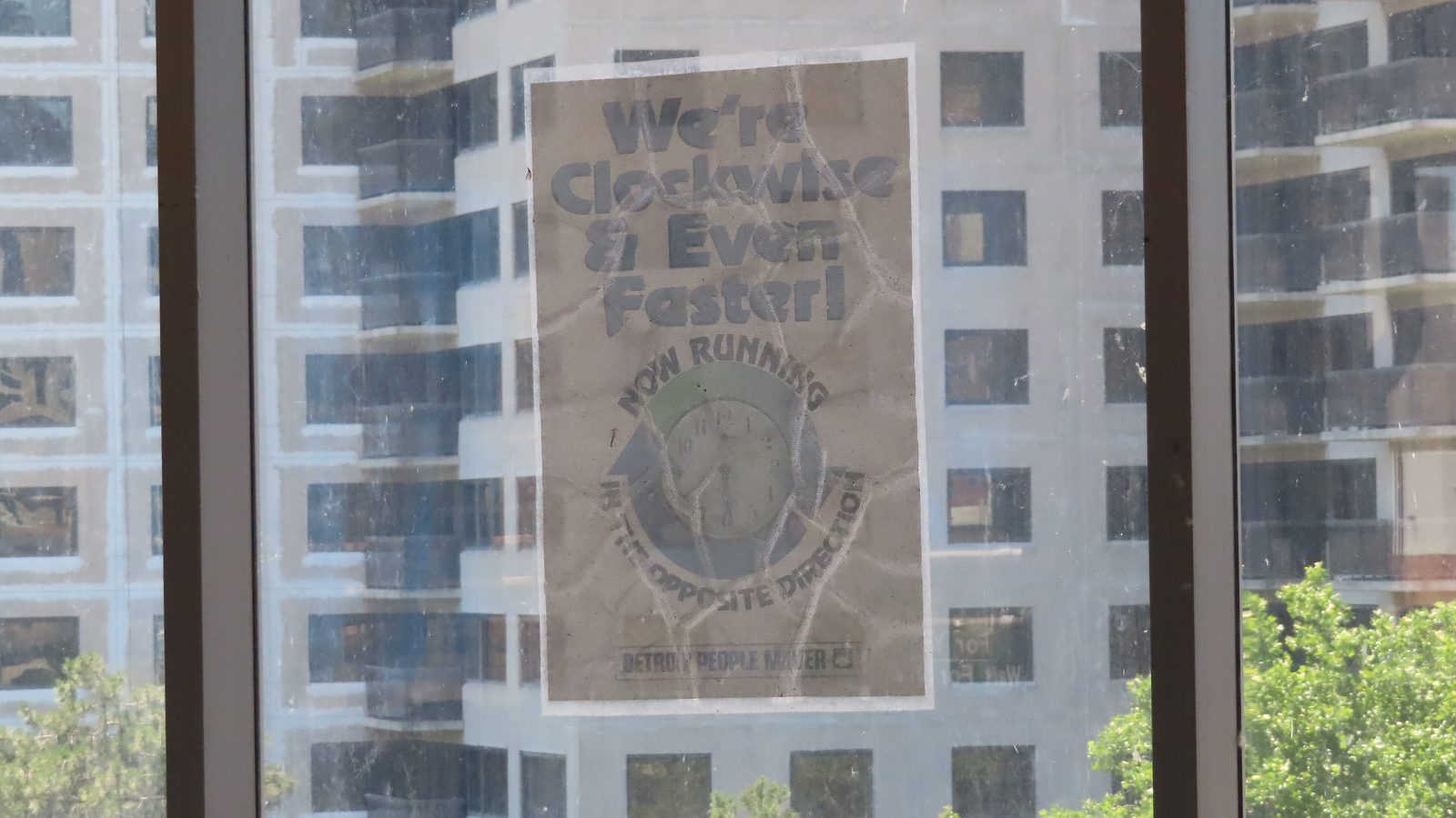
  11. “Clockwise & Even Faster”

    After a short closure to replace track, trains reverse and run clockwise. The loop gets quicker: one short, steep climb, then mostly downhill, letting trains use gravity.

    Wikipedia – Detroit People Mover

  12. LEDs at Millender Center

    Colour-changing LED lighting is added to the Millender Center platform.

    Wikipedia – Detroit People Mover

  13. “The most absurd project”

    Economist Edward Glaeser, in “Triumph of the City”, calls the People Mover perhaps the most absurd public transit project in the country. From September, Greektown station is sponsored as “MetroPCS-Greektown” for a year.

    Wikipedia – Detroit People Mover

  14. 75 cents

    After 24 years the fare rises from 50 to 75 cents, paid with coins or tokens at the turnstiles; a monthly pass costs $10 and an annual pass $100.

    Wikipedia – Detroit People Mover

  15. Grand Circus Park rebuilt

    Grand Circus Park station closes to get a new lobby and lift with the David Whitney Building restoration, reopening on June 13, 2015. 2014 saw 2,357,520 rides and 2015 saw 2,409,894, the peak of the federal record since 2002. The busiest station was Greektown, with 559,048 riders a year.

    Wikipedia – Detroit People Mover · FTA National Transit Database – DTC (50141) monthly ridership

  16. Derailment at Times Square

    A dislodged bracket under a car causes a derailment into the Times Square platform; no one is hurt, and the system stops for 17 hours.

    Wikipedia – Detroit People Mover

  17. The only fatal accident

    A 53-year-old man falls between two cars at Times Square and is killed when the train departs, the only fatal accident in the system’s history. Bollards are added to the platforms afterwards.

    Wikipedia – Detroit People Mover

  18. The streetcar returns: QLINE

    The QLINE streetcar opens on Woodward Avenue with a transfer at Grand Circus Park, largely following the People Mover’s never-built extension towards New Center.

    Wikipedia – Detroit People Mover

  19. Joe Louis Arena closes

    The Red Wings move to Little Caesars Arena and the People Mover loses one of its biggest sources of riders: ridership falls 12 percent in 2018 and another 11 percent in 2019.

    AECOM/DTC – Existing Conditions Assessment (2025-12-10)

  20. Convention Center

    Cobo Center becomes TCF Center and the station is renamed Convention Center. The same year Joe Louis Arena and the footbridge from the station are demolished.

    Wikipedia – Detroit People Mover

  21. Back to the original direction

    Counter-clockwise test runs begin in December; weekends switch in February, and from March 1 the cars run that way full time, back in the 1987 direction after 12 years.

    Detroit Free Press, 2020-02-01 – People Mover to run counter-clockwise · Wikipedia – Detroit People Mover

2020–2023

Silence on the guideway

The pandemic stopped the cars for two years. The restart went station by station, with new names.

  1. The cars stop

    The People Mover shuts down amid the COVID-19 pandemic. The pause lasts more than two years.

    Wikipedia – Detroit People Mover

  2. Reopening postponed

    The planned 2021 reopening is postponed until further notice. In November the convention centre is renamed Huntington Place.

    WDIV, 2021-09-02 – Reopening postponed · Wikipedia – Detroit People Mover

  3. Restart with six stations

    Service returns six days a week at six of the 13 stations: Michigan, Huntington Place, West Riverfront (formerly Joe Louis Arena), Millender Center, Greektown and Grand Circus Park. Rides are free for 90 days, later extended through October.

    The Detroit News, 2022-05-19 – People Mover resumes service · Wikipedia – Detroit People Mover

  4. Station by station

    Broadway and Financial District reopen (June 2), then Renaissance Center and Fort/Cass (September 14), Bricktown (November 21), Cadillac Center (May 23, 2023) and finally Times Square (June 26, 2023). The loop is complete again.

    Wikipedia – Detroit People Mover

  5. Moving into the Guardian Building

    The DTC announces that its offices will move from the Buhl Building across the street to the 29th floor of the art deco Guardian Building.

    Wikipedia – Detroit People Mover

  6. A free year and Toronto cars

    The board approves a one-year fare-free pilot backed by a corporate sponsor. Days later it emerges that the DTC plans to buy the cars and parts of Toronto’s Scarborough RT, a twin system retired in July.

    Detroit Free Press, 2023-12-15 – Free rides in 2024 · CBC News, 2023-12-19 – Scarborough RT trains could have a new home in Detroit

2024–2027

Free, and full of new energy

Free rides, colour-changing column lights, murals, the NFL Draft, cars from Toronto, a storm and plans for the future ahead of the 40th birthday.

  1. Rides become free

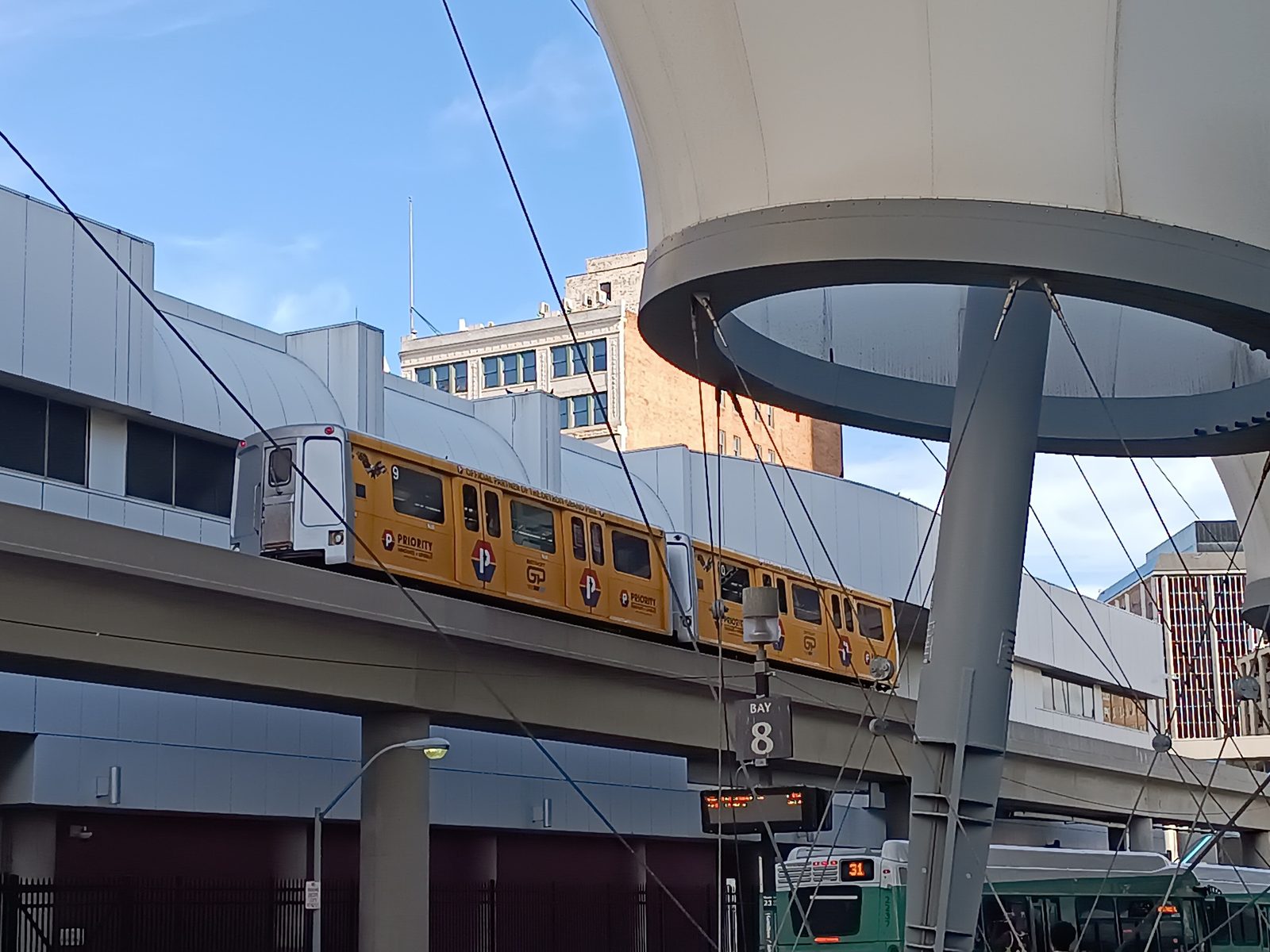
    The fare-free pilot begins: no tickets or passes, and the turnstiles now only count riders. In March Priority Waste becomes presenting sponsor. From January, stations close in turn for real-time tracking, new PA systems, cameras, passenger displays and kiosks.
    Detroit Free Press, 2023-12-15 – Free rides in 2024 · Crain’s Detroit Business, 2024-03-13 – Priority Waste sponsor · CBS Detroit, 2024-01-12 – Stations close for system upgrades · AECOM/DTC – Existing Conditions Assessment (2025-12-10)

  2. Coloured columns and the NFL Draft

    Colour-changing lights come on along the guideway columns on Larned Street and at Grand Circus Park. Around 775,000 people come downtown for the three-day NFL Draft, and the People Mover provides about 70,000 rides.

    Detroit Free Press, 2024-04-17 – Column lighting for the NFL Draft · WDET, 2024-05-08 – 70,000 rides during the NFL Draft · AECOM/DTC – Existing Conditions Assessment (2025-12-10)

  3. The Toronto cars are bought

    City Council approves buying 12 Toronto cars and provides $6.6 million to put them into service; the fare-free pilot is extended through 2025.

    The Detroit News, 2024-06-10 – New railcars from Toronto · AECOM/DTC – Existing Conditions Assessment (2025-12-10) · Wikipedia – Detroit People Mover

  4. Murals and a NASA mural

    Through the City Walls programme five stations get large exterior murals: Fel’le at Michigan Avenue, Nicole Macdonald at Fort/Cass, Nick Pizaña at today’s Water Square, Anthony Lee at Bricktown and Charles “Chazz” Miller at Broadway. Waleed Johnson’s NASA Lifelines mural goes up on the maintenance building.

    Metro Times, 2024 – Murals at five People Mover stations · DTC – About / History of DPM

  5. 1,075,264 rides

    The first free year brings 64 percent more riders than 2023; Renaissance Center overtakes long-time leader Greektown as the busiest station (170,756 boardings), and Cadillac Center jumps from 14,653 to 68,391.

    DTC – About / History of DPM · AECOM/DTC – Existing Conditions Assessment (2025-12-10)

  6. Staying free

    The People Mover stays free for 2025, with extended hours for events.

    The Detroit News, 2025-01-05 – Fare-free for 2025, extended hours

  7. Water Square and a new voice

    West Riverfront station is renamed Water Square after the district rising on the Joe Louis Arena site; developer Sterling Group pledges $500,000 towards the station’s renovation. New station announcements are recorded by Lloyd Jackson Sr. of WJR radio.

    The Detroit News, 2025-07-23 – West Riverfront station renamed Water Square · Wikipedia – Detroit People Mover · Hoodline, 2026-09-08 – Water Square stop begins 6-month facelift

  8. Planning the future

    The System Plan and Downtown Mobility Study begins with AECOM, covering improvements, reconfiguration and expansion. The Existing Conditions Assessment follows in December: the cars are nearly 40 years old, and replacing them would cost more than $70 million.

    WXYZ, 2025-10-03 – People Mover study launched · DTC – System Plan & Downtown Mobility Study · AECOM/DTC – Existing Conditions Assessment (2025-12-10)

  9. 1,321,231 rides

    The best year since 2019: 23 percent more rides than in 2024.

    DTC – About / History of DPM · FTA National Transit Database – DTC (50141) monthly ridership

  10. A new general manager

    Melia Howard becomes general manager of the DTC. In February the board approves harvesting parts from 11 Toronto cars (seven stored in Monroe, four in Tipton, Pennsylvania). The DTC adopts a new mission: “Elevating Detroit”.

    DTC – Board meetings & minutes

  11. Hurricane-force winds

    Gusts of 75 mph (120 km/h) blow objects and debris onto the guideway. A car drags an object along, damaging track equipment and nine of the ten conduits of the Larned Street column lights. The system shuts down.

    Detroit Free Press, 2026-03-23 – People Mover closed after torn track cable · DTC – Board meetings & minutes

  12. MoGo may join the DTC

    A memorandum of understanding signals the DTC’s intention to take over the MoGo bike share from the Downtown Detroit Partnership.

    DTC – Board meetings & minutes

  13. Running again

    After almost two months of repairs and testing, service resumes just ahead of the Movement festival and the Grand Prix.

    CBS Detroit, 2026-05-06 – People Mover resumes service · WXYZ, 2026-05-06 – Service resumes after nearly 2 months of repairs · DTC – Board meetings & minutes

  14. New neon for Greektown

    The board approves a $241,200 contract to replace Stephen Antonakos’s Greektown neon ahead of the 2027 NCAA Final Four in Detroit. In June WSP becomes owner’s representative for the multimodal hub planned beside Michigan Central Station.

    DTC – Board meetings & minutes · DTC – Michigan Central Multimodal Facility

  15. The system plan is ready

    AECOM presents the study with three scenarios: baseline improvements, a system refresh and expansion. A $1.7 million rehabilitation of Water Square station is approved.

    DTC – Board meetings & minutes · DTC – System Plan & Downtown Mobility Study

  16. A riverfront facelift

    A six-month renovation begins at Water Square station: new paint and surfaces, interior and exterior lighting and rebuilt ramps. The station stays open most of the time, with two-day closures planned for work near the guideway.

    Railway Track & Structures, 2026-09-08 – Water Square station upgrades begin Sept. 14 · Hoodline, 2026-09-08 – Water Square stop begins 6-month facelift

  17. The 40th birthday

    The People Mover turns 40 on July 31, 2027, and a festival is planned for the anniversary. According to Historic Detroit, Financial District station may be renamed for Coleman A. Young. Testing and commissioning of the Toronto cars is targeted for 2026–2027, and in April Detroit hosts the NCAA Final Four.

    DTC – Board meetings & minutes · Historic Detroit – Detroit People Mover

Now · The People Mover is free and runs daily. Water Square station is being renovated, the Toronto cars await conversion, and the system turns 40 on July 31, 2027. The live loop above shows where the cars are right now, per timetable.

06 / Art in the Stations

An underground museum, above ground

In 1984 Irene Walt persuaded city leaders that the 13 stations should be more than platforms. The Detroit People Mover Art Commission raised $2 million and commissioned 18 new works from 15 artists, from Detroit’s own Pewabic Pottery tiles to Venetian glass mosaics made by the Crovatto studio in Italy. In 2024 five stations gained exterior murals through City Walls. Source: the DTC’s archived Art in the Stations pages ↗

2024 City Walls murals: Michigan Avenue – Fel’le (Kenyada Kelsaw): “A Peaceful Place”; Fort/Cass – Nicole Macdonald: “Slice of Life in Detroit: Homage to the Working Class”; Water Square – Nick Pizaña: “Detroit Moves People”; Bricktown – Anthony Lee: “Detroit Music Love” (with Big Sean, Aretha Franklin, Eminem and Smokey Robinson); Broadway – Charles “Chazz” Miller: “Welcome to Date Night in Paradise”. Waleed Johnson’s NASA Lifelines mural decorates the maintenance building on Michigan Avenue.

07 / The machine

Linear motors, no driver

The People Mover uses the ICTS (Intermediate Capacity Transit System) developed by Canada’s UTDC, known today as Innovia Metro. The cars have no rotating traction motors: two linear induction motors per car “pull” them along an aluminium reaction rail between the running rails. Their steel wheels roll on continuously welded steel rail, which keeps them quiet, hard-wearing and able to grip steep grades.

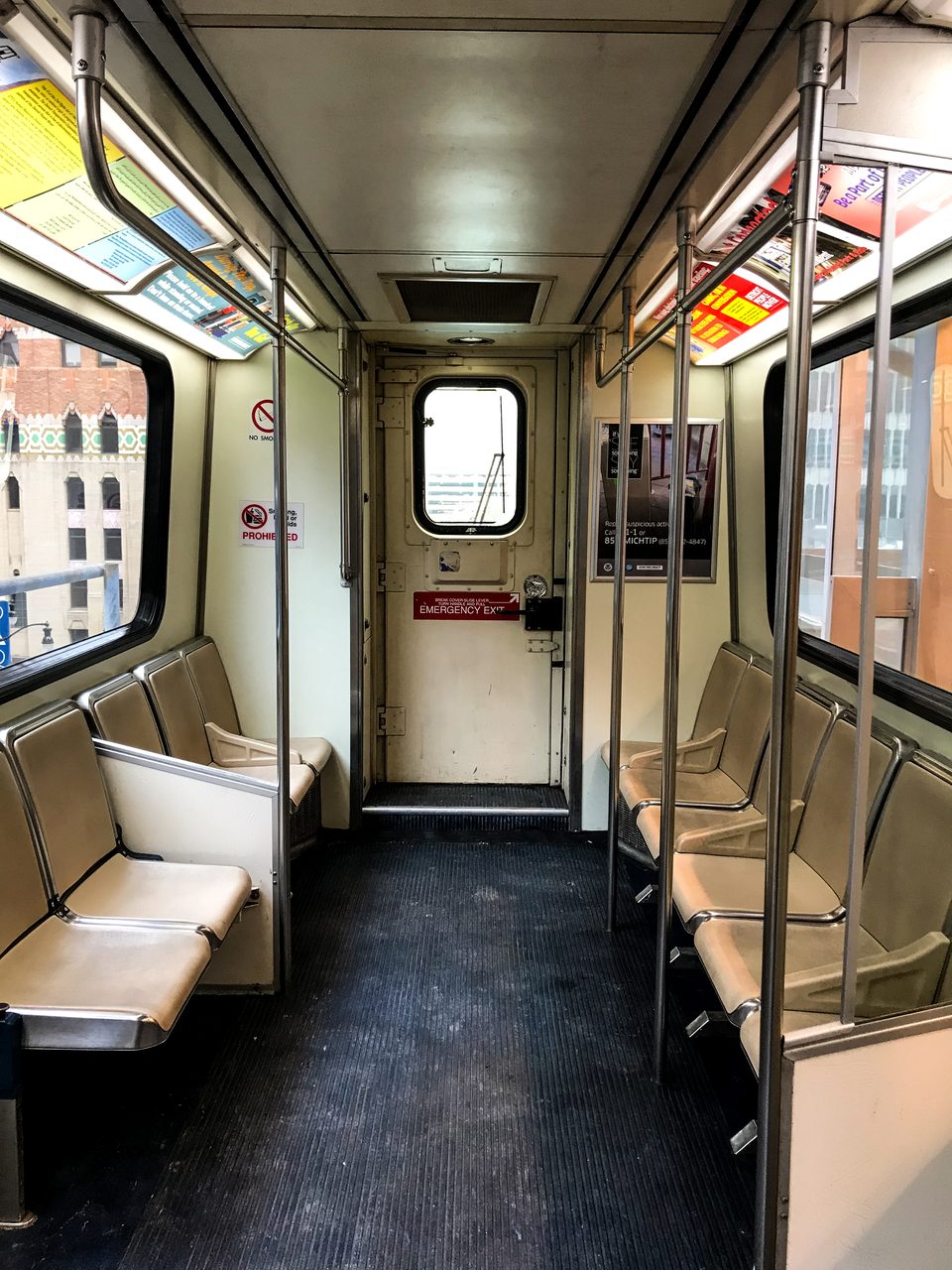
The 12 cars were built in 1986 in Kingston, Ontario. They run in two-car trains but are not married pairs, so any car can couple with any other. Each car has 34 seats and room for 66 standing. Four trains run in normal service and five for events. They are supervised from the maintenance and control facility beside Times Square and communicate through cables laid in the track.

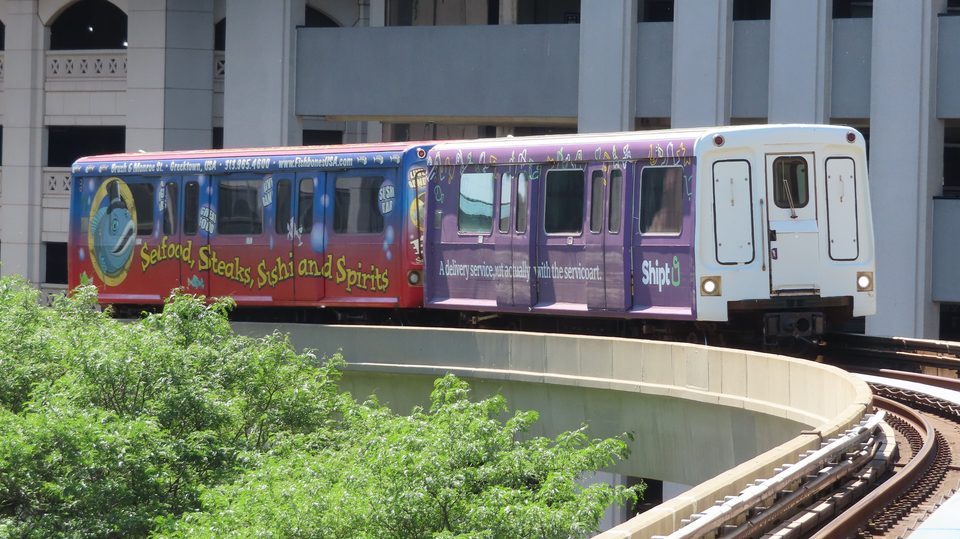
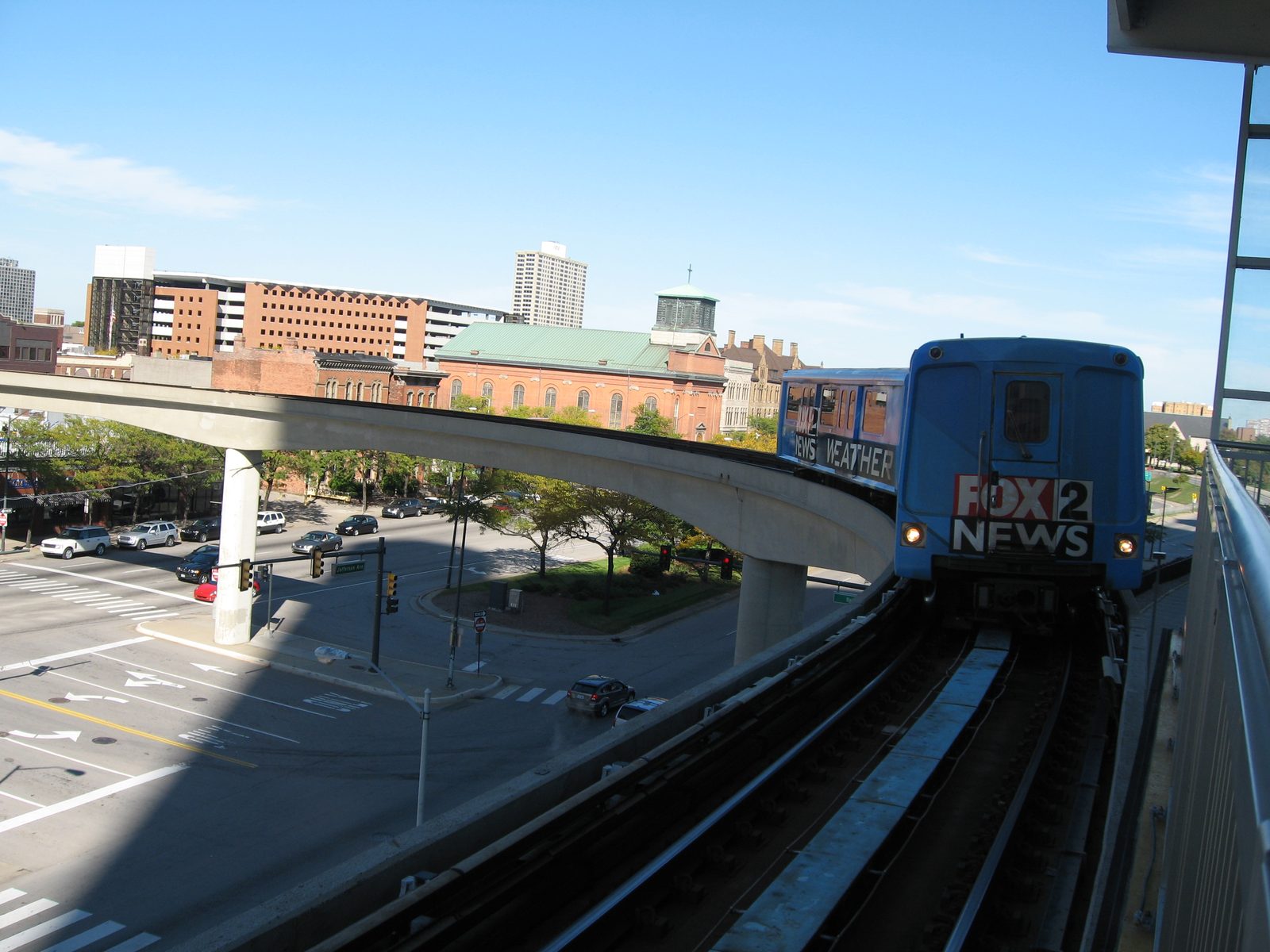
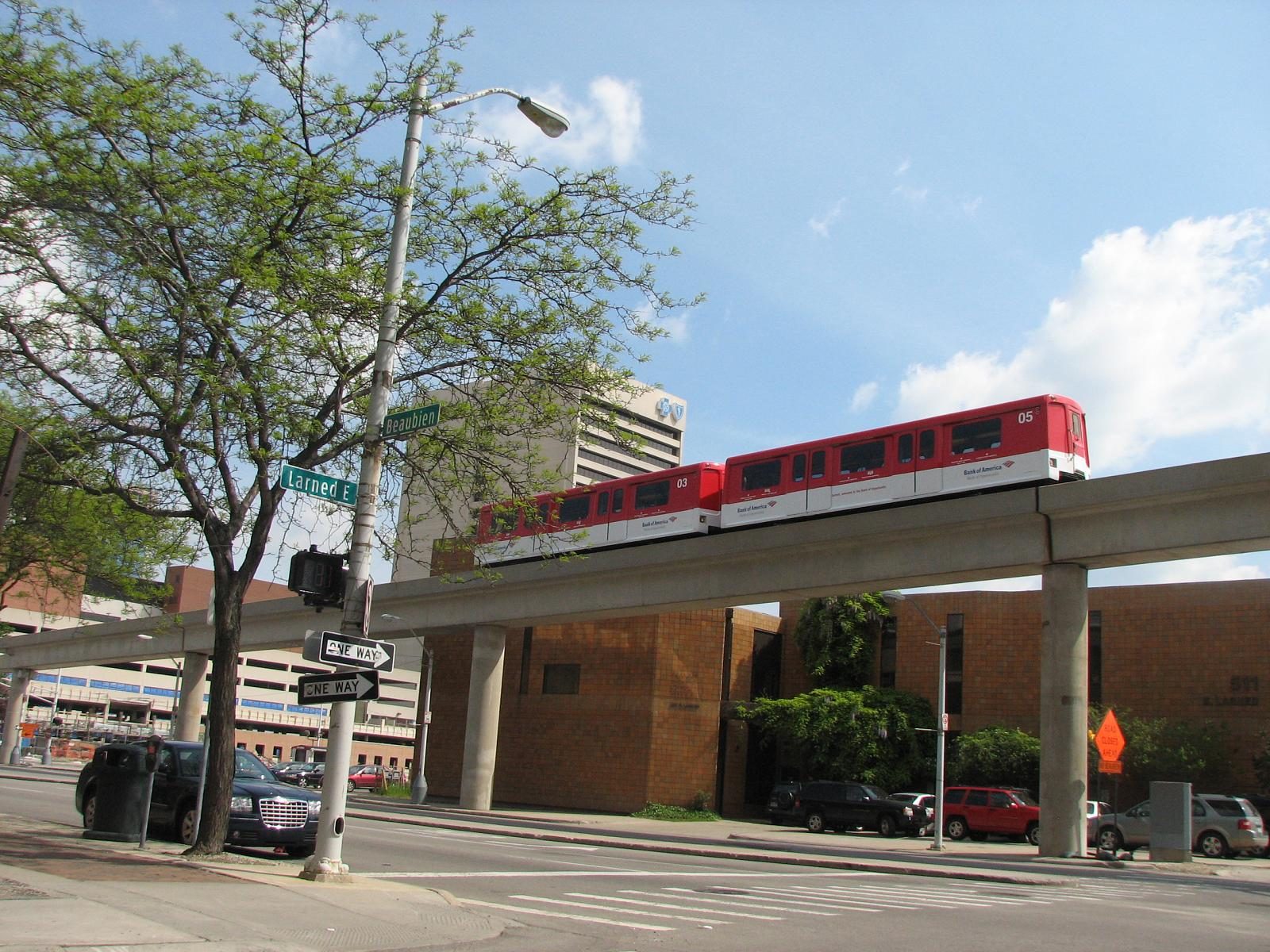
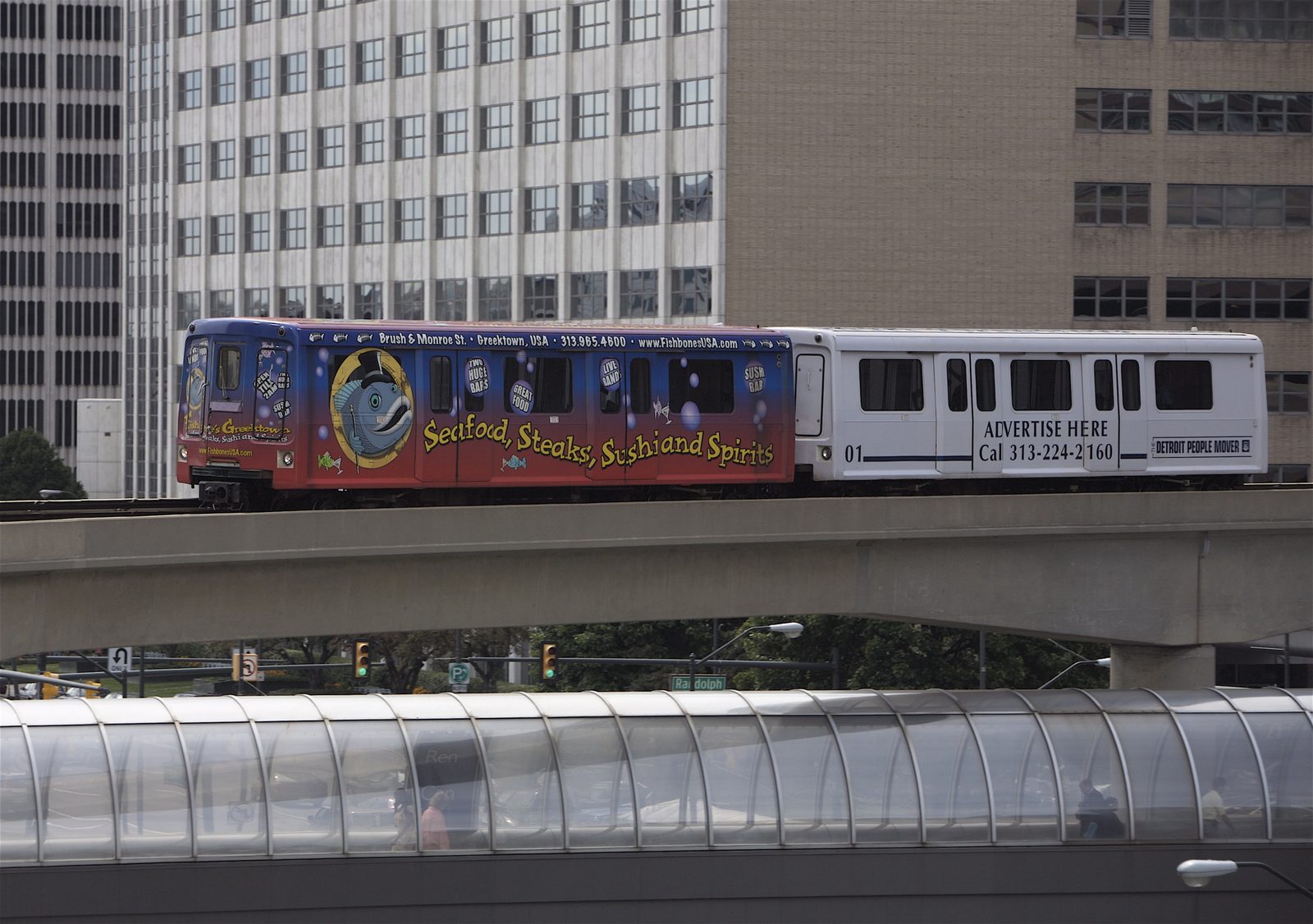
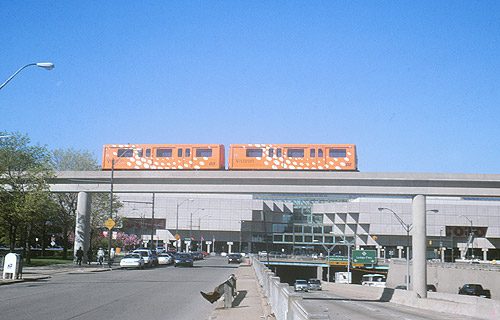
The cars debuted in 1987 in white with green and yellow stripes and have worn advertising wraps since the 2000s. They had a mid-life overhaul in 2007–2010 but are now nearly 40 years old, and one already serves as a parts donor. Their successors are coming from Toronto: the DTC bought the twin but more recently refurbished cars of the Scarborough RT, which closed in July 2023, and conversion and testing are expected in 2026–2027. A brand-new fleet would cost more than $70 million.

Technology
UTDC ICTS Mark Itoday: Innovia Metro
Cars
12, built 198611 in service, 1 parts donor
Capacity
34 seated + 66 standing / cartwo-car trains
Propulsion
2 linear induction motors / carsteel wheel on steel rail
Guideway
2.9 mi, single trackup to 45 ft (14 m) high
Direction
counter-clockwise1987–2008 and since 2020; clockwise 2008–2020
Control
fully automatedcontrol centre at Times Square
Design top speed
56 mph (90 km/h)rarely reached between close stations
Construction cost
$200.3 million80% federal, 20% state
Annual budget
≈ $20 millionDTC, 2026

Sister systems

  • Scarborough RT, Toronto1985–2023

    The twin. Its cars have belonged to the DTC since 2024 and are starting a new life in Detroit.

  • SkyTrain, Vancouversince 1985

    The Expo Line opened with the same technology in December 1985; today it is one of the world’s largest automated metros.

  • Kingston test track1978

    The system was developed on UTDC’s 1.9-km test oval at Millhaven, Ontario.

  • Metromover, Miamisince 1986

    The programme’s other survivor, using rubber-tyred technology.

Riders year by year

Annual rides by calendar year: 2002–2022 and 2026: FTA National Transit Database; 2023–2025: official DTC figures. The first year averaged 11,000–14,000 riders a day. Service was curtailed in 2003 by the Renaissance Center rebuild and in 2020–2022 by the pandemic.
YearRides
2002274,948
2003157,697 Renaissance Center track rebuild
2004950,647
20051,792,924
20062,368,361 Super Bowl XL
20072,324,429
20082,059,714
20092,161,436
20102,216,800
20112,285,358
20122,298,841
20132,207,333
20142,357,520
20152,409,894 peak
20162,165,351
20172,095,415
20181,915,173
20191,605,583
2020269,058 shut from March 30
20210 no service
2022360,571
2023655,283
20241,075,264 fare-free
20251,321,231
2026*496,566 (Jan–Jul) storm closure Mar 13 – May 6

Planners projected 67,000–71,000 daily riders by 1990; the system can carry 15 million a year.

08 / Riding

How to ride

No ticket, no pass: walk up to the nearest station and board. Cars circle in one direction, counter-clockwise, so from any station you reach any other in at most one loop.

Hours

Monday–Friday
6:30 a.m.–midnight
Saturday
10 a.m.–midnight
Sunday
10 a.m.–10 p.m.

Today per timetable: 6:00–23:59

Extended hours for major events. Autumn 2026: October 18 (Free Press Marathon) 5:30 a.m.–10 p.m.; October 24, 8 a.m.–midnight; October 30, 6:30 a.m.–2 a.m.; October 31, 8 a.m.–2 a.m.; November 1, 8 a.m.–10 p.m. (Youmacon). Huntington Place station closes at 10 p.m. on non-event days; Millender Center’s street entrance and skybridge lock at 8 p.m. (exit remains possible). Official current schedule ↗

Fare

Free

Free since January 2, 2024, supported by Priority Waste. The fare was 50 cents (1987–2011), then 75 cents (2011–2023), paid with coins or tokens; the turnstiles now serve as passenger counters.
Accessibility

  • All stations are accessible by lift and/or escalator; Grand Circus Park is lift-only.
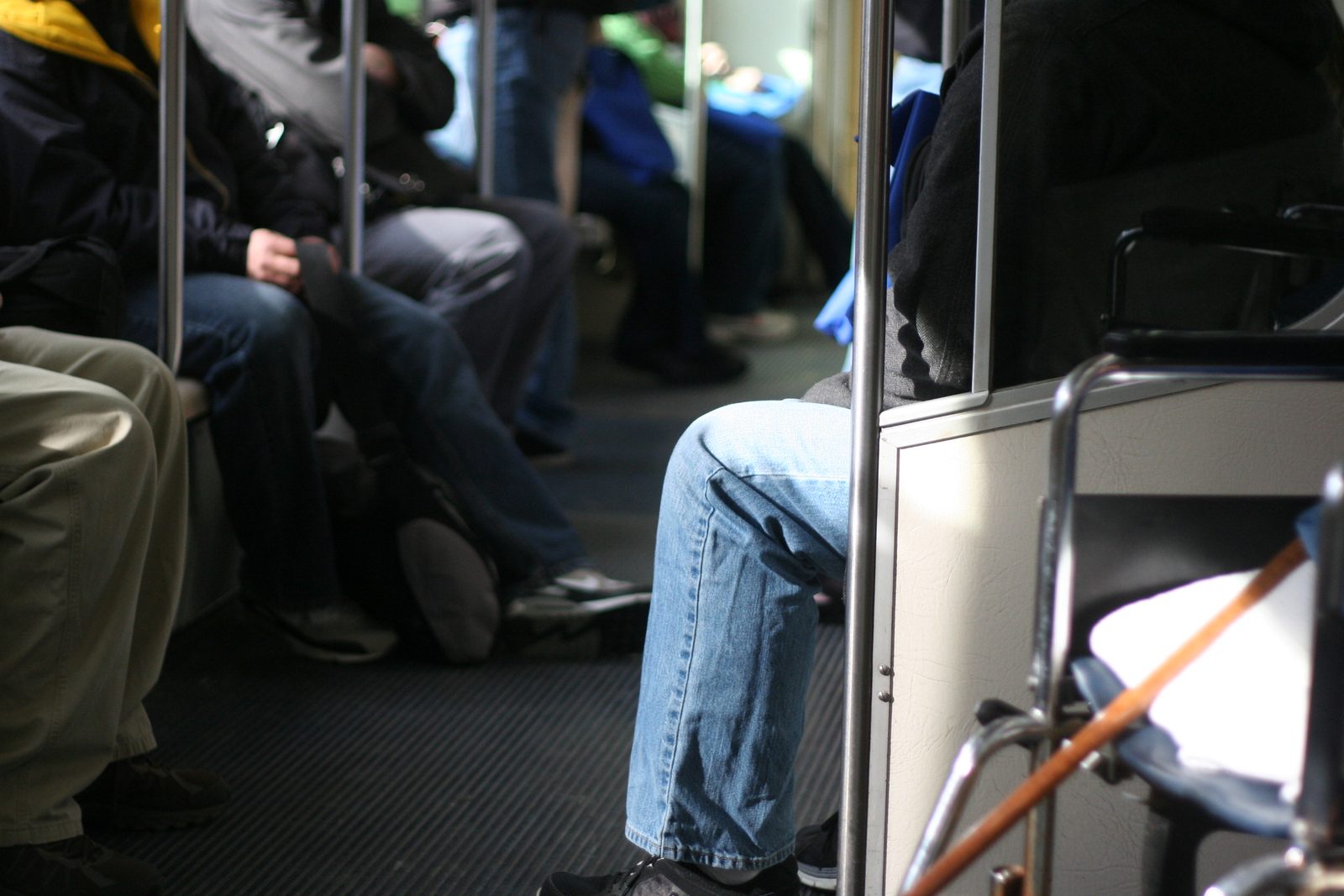
  • Each train has a fold-up seat and securement for one manual wheelchair; mobility scooters may ride too (use their brake).
  • Automated audio announcements at every station, voiced since 2025 by Lloyd Jackson Sr.
  • In autumn 2026 escalators are out of service at Greektown, Michigan, Broadway and Renaissance Center; use the lifts. At Greektown the Hollywood Casino’s Trappers Alley lift reaches the platform.
Tips for your first loop

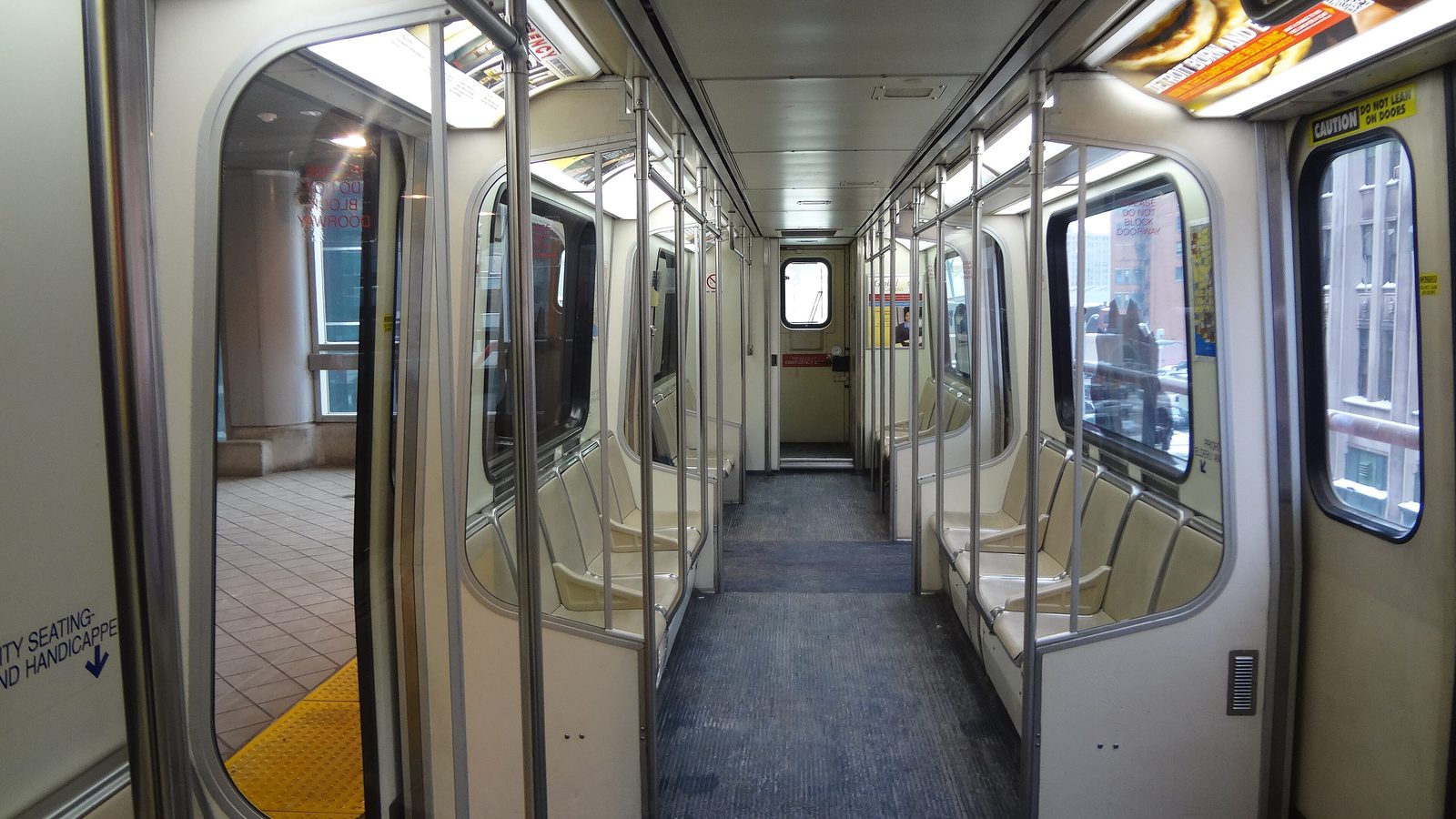
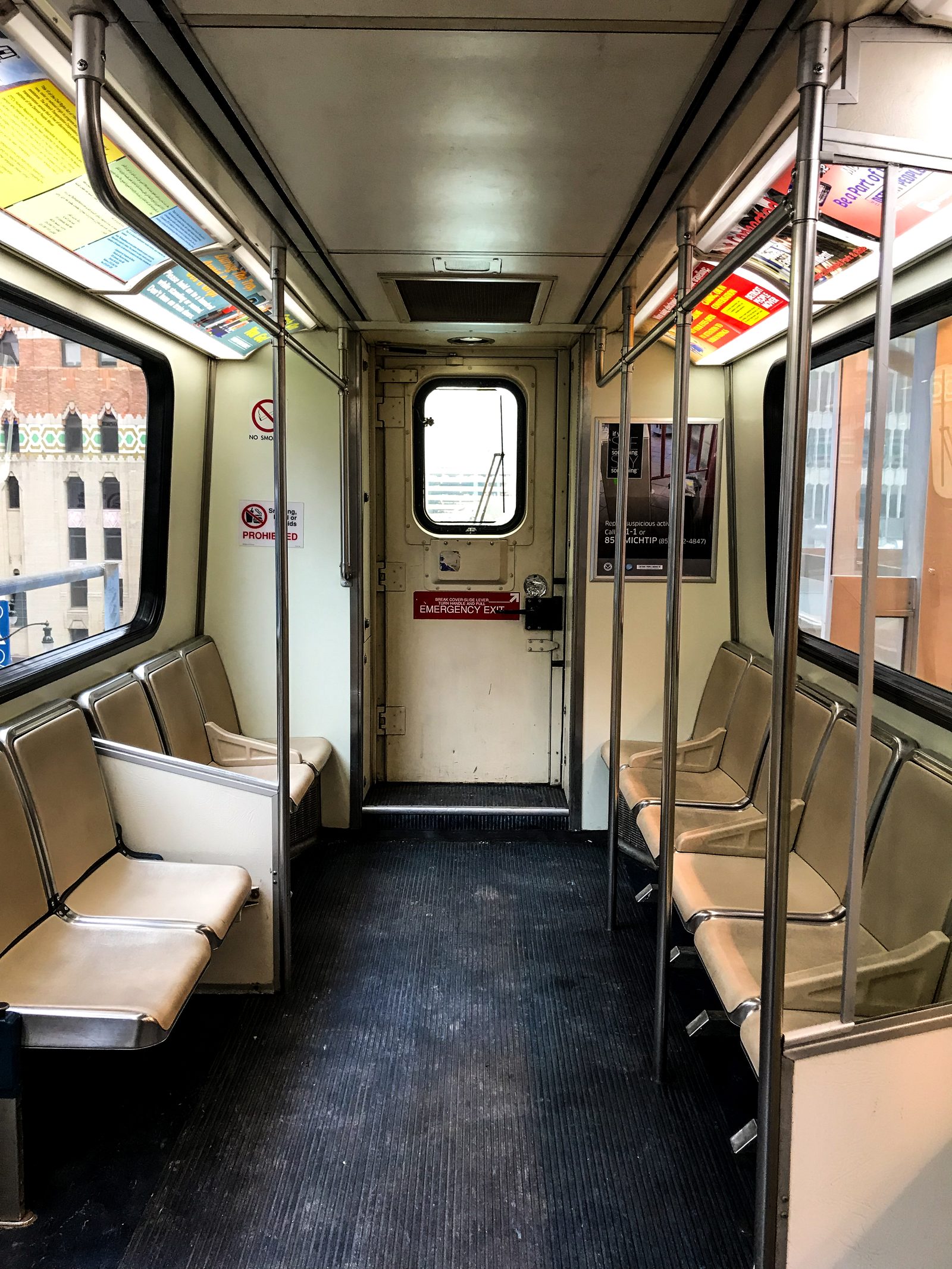
  1. The finest stretch runs from Huntington Place to Financial District: the guideway swings onto the riverfront with Windsor, Canada across the water and the Ambassador Bridge to the west.
  2. Sit on the right-hand side for river views: on the counter-clockwise loop the Detroit River lies to the right between Water Square and Financial District.
  3. A full loop takes 15 minutes and you never have to get off: it is the cheapest (free) sightseeing tour in Detroit.
  4. Before games and shows (Tigers, Lions, Red Wings, concerts) park at the edge of downtown and ride in; the DTC itself recommends it.
  5. Art walk: hop off at each station for a minute to see the art; the bronze runners at Michigan Avenue and the newspaper reader at Grand Circus Park are favourites.
  6. After dark look along Larned Street, where the guideway columns glow in colour since 2024.

Contacts

DTC customer assistance & officeMon–Fri 9–5 · suggestions and concerns
(313) 224-2160
Control Center – emergenciesduring People Mover service
(313) 963-0171
Communications, press, filmingfax: +1 (313) 224-2134
MarCom@thepeoplemover.com
Mailing address & officeclosest to Financial District station
The Guardian Building, 500 Griswold St., Suite 2900, Detroit, MI 48226
Official website
thepeoplemover.com ↗
Schedule and daily status
thepeoplemover.com/schedule ↗
Hollywood Casino security (Greektown lift)if the lift is out; casino entry 21+ only
(313) 309-5350

Social media

Contacts checked: 2026-09-25

09 / Culture

In films, songs and on walls

The once-mocked “train to nowhere” became a favourite of filmmakers, musicians and muralists; the DTC even runs its own permit process for filming on its trains and stations.

  • Film · 2011

    Real Steel

    The Renaissance Center’s Jefferson Avenue entrance, with its “Jetsons-style” People Mover, plays “Tarryton Towers” in Hugh Jackman’s robot-boxing film.

  • Film · 2014

    Transformers: Age of Extinction

    In an action sequence filmed in Detroit in summer 2013, as CBS Detroit reported, the People Mover derails and people run screaming.

  • Documentary · 1988

    Art in the Stations

    The 30-minute film on the station art by Oscar winners Sue Marx and Pamela Conn, premiered at the DIA in 1989.

  • Music · 2007

    Big Sean: “People Mover”

    A track on the Detroit rapper’s first mixtape, Finally Famous. His face appears beside Aretha Franklin, Eminem and Smokey Robinson on the Bricktown station mural (MLive, 2025).

  • Music · 2020

    Squarepusher: “Detroit People Mover”

    A track on the British electronic musician’s album Be Up a Hello, with a video shot on board.

  • Book · 2004

    Irene Walt: Art in the Stations

    A coffee-table book on the art of all 13 stations, photographed by Balthazar Korab (ISBN 0-9745392-0-1).

Curiosities

  • It has reversed twice

    It opened counter-clockwise in 1987, switched to clockwise in 2008 (“Clockwise & Even Faster”) and went back on March 1, 2020.

  • The same train as Vancouver

    The cars are siblings of Vancouver’s SkyTrain and Toronto’s Scarborough RT, whose cars are now moving to Detroit.

  • Canada from the window

    From the riverfront stretch you look across to Windsor; few American urban railways offer a view of another country.

  • A rare downtown people mover

    Only Detroit, Miami and Jacksonville built downtown automated systems under the federal programme; all three still run.

  • Eight stations inside buildings

    Eight of the 13 stations are built into buildings, linking more than 9 million square feet of interior space.

  • In Arabic and Spanish too

    Some station signs are also in Arabic and Spanish, reflecting Detroit’s large Arab and Latino communities.

  • Busiest times

    The first-year one-day record was 54,648 rides; January 2006 (Super Bowl XL and the auto show) is the busiest month on federal record, with 399,032 rides.

  • The token era

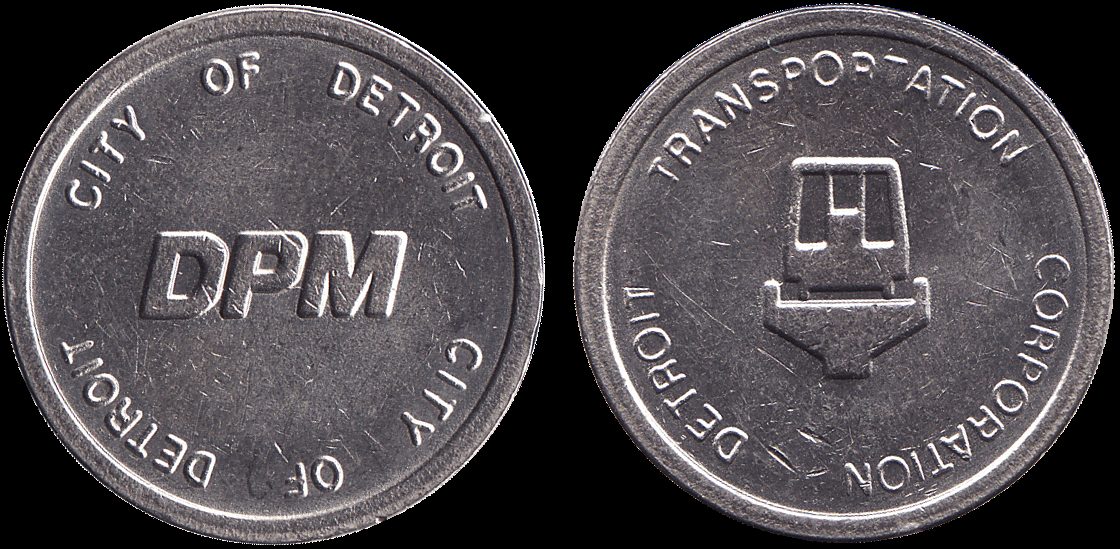
    Until 2023 riders passed the turnstiles with “City of Detroit – DPM” tokens or quarters; the equipment dates from 1986–1988.

Videos

The video loads only after a click, from youtube-nocookie.com.

11 / Questions

Frequently asked questions

How much does the People Mover cost?

Nothing. It has been free since January 2, 2024; no ticket or pass is needed.

When does it run?

Monday–Friday 6:30 a.m.–midnight, Saturday 10 a.m.–midnight, Sunday 10 a.m.–10 p.m., longer for events. The official site ↗ shows the daily status.

How often do trains come?

In autumn 2026 the DTC quotes 8–12 minutes on average; the official timetable file describes four-train service at about 4-minute intervals. A full loop takes 15 minutes.

Which way does it go?

One way, counter-clockwise on a north-up map: Times Square → Michigan → Fort/Cass → Huntington Place → Water Square → Financial District → Millender Center → Renaissance Center → Bricktown → Greektown → Cadillac Center → Broadway → Grand Circus Park.

Is there a driver?

No. It has been fully automated since 1987 and is supervised from the control centre beside Times Square.

Is it accessible?

Yes: every station has a lift and/or escalator, and the cars have wheelchair securements. Details: ADA page ↗.

Which station for the stadiums?

Comerica Park and Ford Field: Broadway or Grand Circus Park; Little Caesars Arena and the Fox Theatre: Grand Circus Park; the convention centre: Huntington Place.

How do I get to Canada?

The Linq tunnel bus to Windsor leaves near Millender Center station ($15, card only); bring a passport.

Why was it called the “train to nowhere”?

Because it was designed to distribute riders from a subway and commuter network that was never built; without that network it only links downtown.

What happens to the old cars?

In 2024 the DTC bought Toronto’s Scarborough RT cars of the same type but refurbished more recently; their conversion and testing are expected in 2026–2027, with the old cars serving as parts sources.

Sources · checked: 2026-09-25

Every figure is compiled from the sources below, including the DTC’s official pages, board minutes and its 2025–2026 planning documents. Where sources differ, we give both. Photos: Wikimedia Commons, freely licensed and credited per author.

Save the plan. Share the moment.