42°19′ N   83°02′ WINDEPENDENT CITY GUIDE · HU / ENDETROIT + MICHIGAN
QUARTER
DETROIT
Menu

Events

Eat & drink

Things to do

Plan

Stay

For hotels

Shows & music

Getting around

People & community

About usFor venues

What's the weather really like in Detroit?

DETROIT / Weather & seasons / ¼

What's the weather really like in Detroit?

Detroit gets four honest-to-goodness seasons: snowy, biting winters, a spring that takes its time, warm summers with thunderstorms, and a glowing fall. Here's what each month actually feels like, what to pack, and what to do if the sirens go off.

average July high (29 °C)
84°F
average January high (0 °C)
32°F
of snow in an average season (114 cm)
45 in
odds of a white Christmas
35%

© Wikimedia Commons · CC BY-SA 3.0

What’s the weather doing right now?

The next few days from the official forecast, in Fahrenheit and Celsius.

  1. This Afternoon26°C 78°FSlight Chance Rain ShowersChance of rain 17%
  2. Tonight13°C 55°FShowers And ThunderstormsChance of rain 98%
  3. Friday18°C 65°FChance Rain Showers then Mostly CloudyChance of rain 44%
  4. Friday Night8°C 47°FMostly ClearChance of rain 0%
  5. Saturday18°C 64°FSunnyChance of rain 0%
  6. Saturday Night8°C 47°FMostly ClearChance of rain 0%
  7. Sunday21°C 70°FSunnyChance of rain 0%
  8. Sunday Night8°C 46°FMostly ClearChance of rain 0%

Forecast: National Weather Service, Detroit/Pontiac office, refreshed every 30 minutes.

What's Detroit really like, month by month?

These are official 30-year normals (1991–2020): NOAA's station at Detroit Metro Airport for Detroit, and HungaroMet's Pestszentlőrinc station for Budapest. The short version: summer and early fall are a near match for Budapest (September here is even a touch warmer), but winter bites harder, with February running 7–9°F colder by day and by night, and spring arrives later. All that even though Detroit sits roughly level with Rome.

October

Average high
17°C 62°F
Average low
7°C 44°F
Precipitation
64 mm 2.53 in
Snowfall
0 cm 0 in
Daylight
11.0 hours
Budapest, same month
16.4° / 7.2°C

Crisp and colorful: the trees turn, 60s afternoons slide to the mid-50s by Halloween, and the first frosty nights show up. Layers: a sweater, a warmer jacket, closed shoes, and gloves for evening plans late in the month.

What’s on in Detroit then? ↗

Detroit Metropolitan Airport (DTW) · 1991–2020 · long-term normals; daylight is for the middle of the month

When should you make your first trip?

There's no bad season, only the wrong shoes. Still, for a first visit, these windows give you the most.

  • September: our pick

    Mid-70s afternoons, cool evenings, and the outdoor season is still in full swing. It opens with Labor Day weekend, when jazz takes over downtown. On the 30-year averages, Detroit is even a little warmer than Budapest this month.

  • Late May and June: green, with long evenings

    Highs from about 70°F to 80°F, parks in full leaf, and in late June the sun sets after 9 pm. Memorial Day weekend belongs to the Movement techno festival at Hart Plaza. The trade-off: it's prime thunderstorm season, so keep an eye on the forecast.

  • July and August: peak summer

    Mid-80s highs, and July averages about five days of 90°F or more. Riverfront, Belle Isle, festivals. Save the hottest afternoon hours for a museum or an air-conditioned café.

  • October: color and cider

    Crisp afternoons from the low 60s down to the mid-50s, trees changing color, cider, donuts and Halloween. Dress in layers, because it cools off noticeably by the end of the month.

  • December: lights and skating

    Highs around freezing and dark by about 5 pm, but you get the big tree lighting and the rink at Campus Martius. Roughly one year in three brings a white Christmas, too.

  • January to March: for winter lovers

    The coldest stretch: in January, about half the days stay below freezing. If you come now, build the trip around indoor Detroit: museums, theaters, jazz clubs, hockey and basketball.

  • April: a gamble

    The average high is 59°F, yet about an inch and a half of snow still falls on average, and showers are frequent. Fine if you plan indoor days and dress in layers for the outdoor bits.

What should you pack?

Tick off what's already in the bag. What to expect in each month is in the table above.

Your ticks are remembered in this browser only; we don’t send them anywhere.

What should (and shouldn't) worry you?

US weather alerts come in three levels: an advisory (take care), a watch (it could happen, get ready) and a warning (it's happening or about to, act now). Here are Detroit's main players.

  • Lake-effect snow? Not really Detroit's thing

    Lake-effect snow forms when cold air, often from Canada, crosses the unfrozen Great Lakes and dumps snow in narrow bands. That's really a Lake Michigan shore specialty: the official 30-year average is 87.2 inches a season in Muskegon and 77.6 in Grand Rapids, against 45.0 in Detroit. Lake Huron bands sometimes reach the Thumb and Macomb and St. Clair counties; Detroit itself only gets clipped now and then.

  • Winter storms and snow

    Winter Storm Warning: significant snow, ice or blowing snow is coming. Winter Weather Advisory: a nuisance, but milder. Detroit averages about 14 days a year with an inch or more of new snow. Driving? Our driving guide covers winter on the road.

  • Freezing rain and ice

    Freezing rain freezes on contact, glazing roads, sidewalks, trees and power lines. An Ice Storm Warning usually means about a quarter inch of ice or more. Take short steps and hold the railing.

  • Dangerous cold

    Since October 1, 2024, the alerts are called Cold Weather Advisory and Extreme Cold Watch and Warning, replacing the old wind chill alerts. Detroit averages 3–4 nights a year at 0°F or below, and the wind makes it feel far colder.

  • Heat waves

    Heat Advisory: dangerous heat. Extreme Heat Watch and Warning: the top tier, called Excessive Heat until March 4, 2025. Detroit averages 13 days a year at 90°F or more, and the heat index tells you how hot it feels with the humidity. Drink plenty and spend the afternoon peak somewhere cool indoors.

  • Thunderstorms

    Severe Thunderstorm Watch: severe storms are possible, stay tuned. Severe Thunderstorm Warning: spotters or radar have it, danger is imminent. Get inside a sturdy building, and if you hear thunder, don't hang around the waterfront or open ground.

  • Tornadoes: watch or warning?

    In Southeast Michigan tornadoes peak in June, most come between April and August, usually between 4 and 6 pm, and most are on the weak end. Tornado Watch: possible, be ready. Tornado Warning: one has been sighted or shows on radar, so get to an interior, windowless room on the lowest floor right away.

  • What do the sirens mean?

    Detroit has 56 outdoor sirens. They're tested at 1 pm on the first Saturday of every month, and that's just a drill. Any other time, it means a Tornado Warning or a storm with winds of 70 mph or more: get inside, down to the lowest level, away from windows. The sirens are built for people outdoors, so you may not hear them inside.

  • Smoke and air quality

    In summer, smoke from Canadian wildfires can foul the air: on July 15, 2026, for example, Michigan's environment agency (EGLE) put the whole state under an air quality alert. Check the current index on AirNow.gov; at orange, sensitive groups should scale back time outdoors.

How do you read a US forecast?

Fahrenheit, inches, miles per hour and a pile of jargon. Here's your cheat sheet; the exact conversion is °C = (°F − 32) × 5/9.

What you seeWhat it meansGood to know
32°F0 °C, freezingBelow this, puddles turn to ice and sidewalks get slick.
50°F · 68°F · 86°F10 · 20 · 30 °CQuick estimate: subtract 30, then halve it.
0°F−18 °CDetroit averages 3–4 nights a year at or below this.
90°F32 °CDetroit averages 13 days a year at or above this.
Wind chillHow cold it feels on your skin once the wind is factored in0°F plus a 15 mph wind = a −19°F wind chill.
Heat indexHow hot it feels once humidity is factored inIt's figured for shade; full sun can add up to 15°F.
Feels likePerceived temperature: wind in winter and humidity in summer can push it away from the real readingDress for this number, not the plain one.
40% chance of rainA 40% chance that your spot gets at least 0.01 inch during that periodIt doesn't mean rain for 40% of the day.
1 inch2.54 cmSnow totals come in inches too: 4 inches is about 10 cm.
15 mph24 km/hMultiply mph by 1.6 to get km/h.
Advisory · Watch · WarningTake care · It could happen, get ready · It's happening, act nowA warning is the one to act on.
AQIAir Quality Index: green 0–50, yellow 51–100, orange 101–150, red 151–200Orange affects sensitive groups; at red, everyone may feel it.

Why do you look south to see Canada?

The Detroit River runs 28 miles from Lake St. Clair to Lake Erie, and the international border runs right down it. To see Canada from downtown, you look south: Windsor sits on the south bank, one of only two places where a Canadian city lies south of an American one.

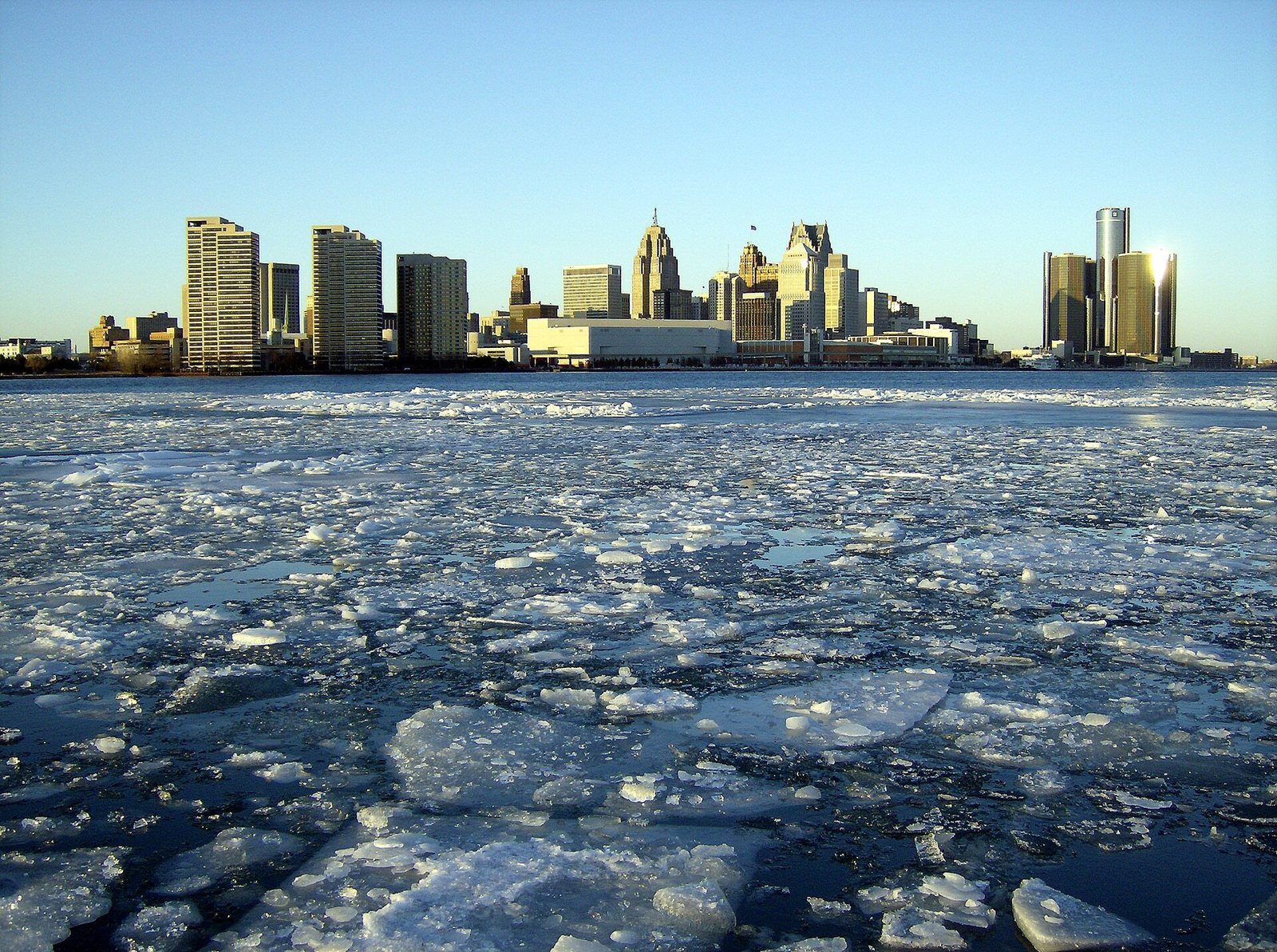
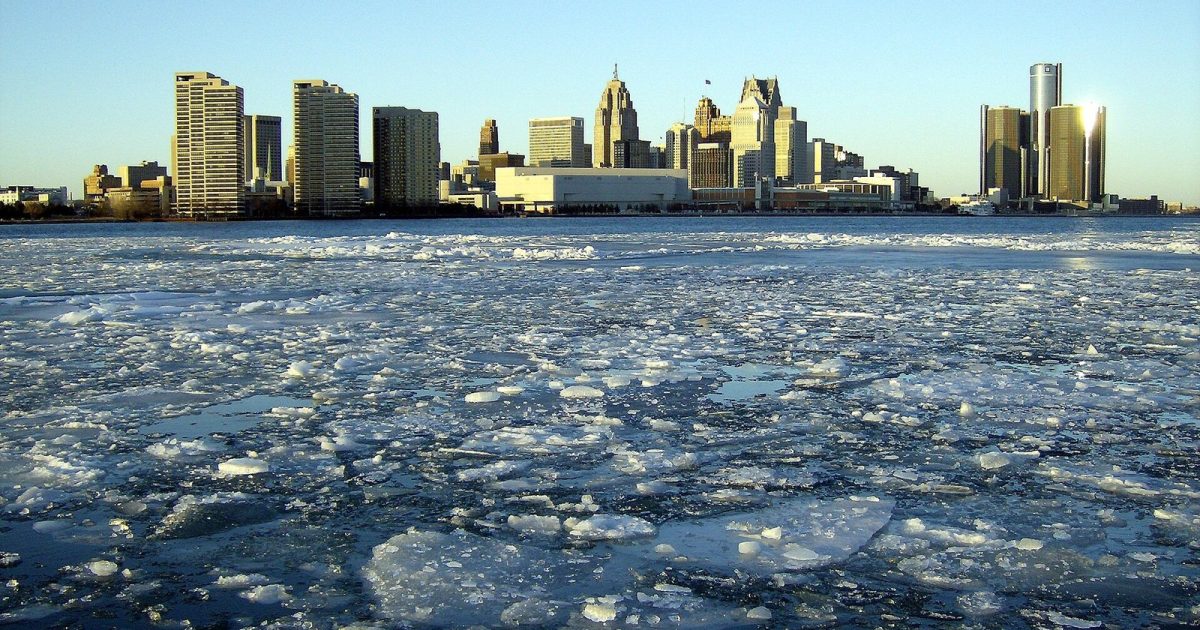
In summer the Riverwalk and Belle Isle are the city's living room: walk, bike, picnic, and in late June catch the sun going down after 9 pm. Summer's big fireworks show bursts over the river, too. In a hard freeze, ice floes drift down the river, as in the photo up top, taken from Windsor. It can feel noticeably cooler and windier by the water than a few blocks inland, so bring an extra layer.

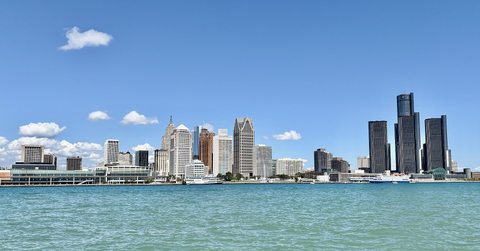
The best postcard view of Detroit is actually from Windsor, where riverfront parks face the skyline for about 5 km (3 miles). You can cross on the Ambassador Bridge, through the tunnel, or, since July 27, 2026, on the Gordie Howe International Bridge, whose walking and biking path is free. Bring your passport and check the entry rules before you go.


What do people ask us most?

Is Detroit colder than Budapest?

In winter, yes. Detroit's average February high is 35°F against Budapest's 42°F, and the nights average 21°F against 30°F. Summer is nearly a tie, with July highs of about 84°F versus 83°F, and September is a touch warmer in Detroit. Detroit also gets about 1.5 times as much precipitation: 34.3 inches a year against Budapest's 23.

How much snow does Detroit get?

About 45 inches in an average season, with January the snowiest at 14 inches. Roughly 14 days a year bring an inch or more. Snow can fly from November to April, but most of it comes December through March.

What's the time difference with Budapest?

Usually six hours, with Detroit behind. But the clocks change on different dates: in the US on the second Sunday in March and the first Sunday in November, in Europe on the last Sundays of March and October. So from October 25 to November 1, 2026, and from March 14 to March 28, 2027, the gap is only five hours.

Will I get a white Christmas?

According to the National Weather Service in Detroit, from 1874 to 2025 there was at least an inch of snow on the ground on Christmas 34.7% of the time, so roughly one year in three. The average Christmas Day high is 33°F.

Do tornadoes hit Detroit?

They do happen in Southeast Michigan: mostly April through August, peaking in June, usually between 4 and 6 pm, and most are weak. If there's a Tornado Warning, or the sirens sound outside the monthly test, get to an interior, windowless room on the lowest floor. The test is at 1 pm on the first Saturday of each month.

Where can I get a reliable forecast?

Straight from the National Weather Service office for Detroit at weather.gov/dtx, which also lists every active alert. For air quality, AirNow.gov is the official source.

Sources & fact check · Checked: 2026-10-01

Save the plan. Share the moment.

quarterdetroit.comDetroit Weather and Seasons: What Each Month Is Really Like · Quarter DetroitHere’s what your friends will see
More ways to shareDiscord · Viber · Instagram · Microsoft Teams · Slack · LINE · Pinterest · Tumblr · Mastodon · Nextdoor · Flipboard · Gmail · Outlook · Yahoo Mail · With a QR code

With a QR code

Scan it with another phone, or hold it up to a friend’s camera.